
Credit assets ended the third quarter of 2026 on a softer note. While geopolitical and fiscal uncertainties warrant caution, resilient growth and solid corporate fundamentals remain supportive. At the same time, higher interest rates have increased embedded yields, offering more attractive carry and improved medium-term return prospects.
1. Rising sovereign yields enhance the attractiveness of investment grade credit
Credit indices have been under pressure since the beginning of the year, primarily due to the sharp rise in short-term rates across developed markets following the escalation of the conflict involving Iran and the United States. This higher-rate environment has mechanically weighed on bond valuations.
The prospect of persistently high energy prices and significant disruptions to global trade has fuelled inflation expectations and prompted a swift response from major central banks.
To contain the inflationary shock and prevent it from spreading to broader price components, central banks have embarked on a new tightening cycle: the European Central Bank has already raised rates twice, compared with one hike by the Federal Reserve, while both have adopted a more hawkish stance.
This shift in policy has led to a significant repricing of monetary policy expectations, with markets now pricing in three additional rate hikes on both sides of the Atlantic over the next twelve months.
The tightening already implemented, combined with expectations of further rate hikes, has driven a sharp rise in sovereign yields, with German yields increasing by 105 bps and their US counterparts by 142 bps.
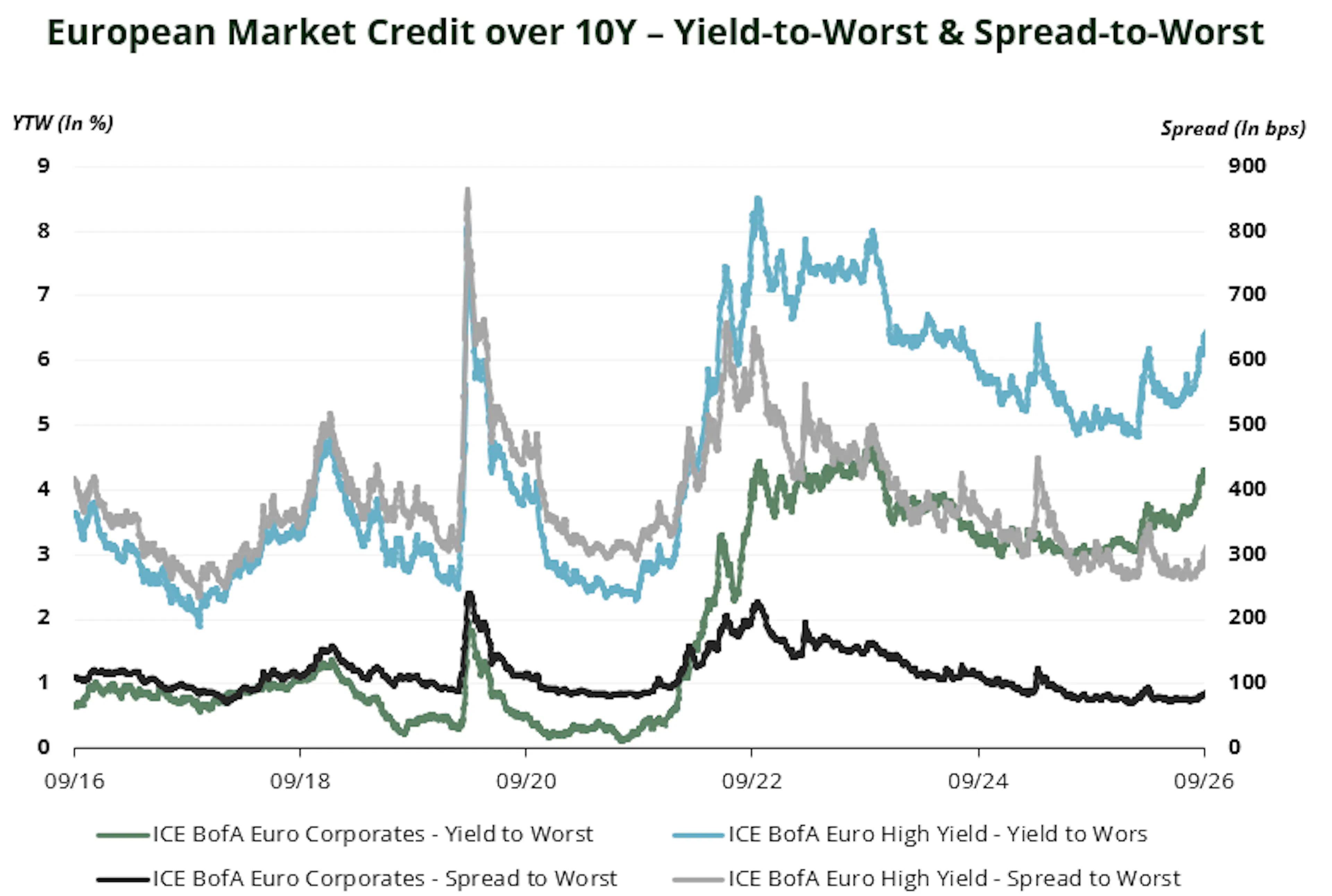
This move has particularly weighed on Investment Grade credit, where lower carry and longer duration provide less protection against rising rates. However, the correction has also significantly increased embedded yields, enhancing carry potential and improving the medium-term return outlook for the asset class (see Figure 1).
2. Signs of overheating in leveraged finance market
Despite an environment characterised by persistently high interest rates, less supportive energy prices and abundant bond supply, leveraged finance markets have so far demonstrated remarkable resilience.
Abundant liquidity and investors’ search for yield have long provided financing to the most speculative business models, facilitating refinancing despite a gradual deterioration in credit discipline and capital allocation efficiency in recent years.
However, this support is beginning to fade. With rates experiencing their sharpest increase since 2022 and flows into certain leveraged finance segments starting to reverse, the vulnerabilities of some business models are becoming increasingly apparent.
This trend is particularly visible in private credit, which has long been shielded by lower liquidity and therefore less visible volatility, but also in riskier segments of liquid markets, including CLO equity tranches and CCC-rated corporate credit.
Against this backdrop, a widening in credit spreads appears natural to us, as the risk premia observed until recently no longer provide sufficient compensation for the fundamental and structural risks embedded in certain issuers.
We therefore expect greater dispersion across leveraged finance markets, creating a particularly favourable environment for security selection. This normalisation in valuations should broaden the opportunity set and enable active managers to generate attractive absolute and relative returns during the next phase of the credit cycle.

3. Which credit segments are favoured going forward?
Late-cycle phases can be particularly challenging to navigate, given the growing number of sources of uncertainty, as illustrated by the current environment. Against this backdrop, capital preservation and disciplined issuer selection become increasingly important.
In credit markets, avoiding credit events remains one of the key drivers of long-term performance, as defaults and liability management exercises (LMEs) typically result in the crystallisation of losses.
While rising interest rates have weighed more heavily on some defensive credit segments, the decline in valuations has also resulted in a significant increase in embedded yields, enhancing their future return potential in the absence of credit events.
Against this backdrop, we believe Investment Grade credit offers particularly attractive potential for the coming months. Its greater interest-rate sensitivity and more resilient spreads could provide better protection in the event of an economic slowdown. It also represents a high-quality pool of liquidity that could be redeployed into riskier segments should market dislocations create more compelling opportunities.
Financial debt, particularly subordinated debt, has also suffered from the widening in sovereign spreads, especially in France and peripheral countries. However, we believe this move has been partly excessive given the structural improvement in bank fundamentals: stronger capital buffers over the past decade, well-controlled cost of risk and improved profitability in the current rate environment -which all provide support for European banks.
Current market levels are therefore creating attractive investment opportunities, particularly as the monetary tightening currently priced by markets appears demanding. The current environment allows investors to lock in attractive yields from Investment Grade issuers, while this exposure could also benefit from lower interest rates should the economic outlook deteriorate.
Finally, the credit market offers unparalleled depth and granularity, with tens of thousands of issuers worldwide. This broad opportunity set enables active managers to continuously identify attractive risk/reward profiles by exploiting market inefficiencies and selecting issuers whose fundamentals may be misunderstood or insufficiently valued by the market.

4. Carmignac Portfolio Credit: well positioned to benefit from this shift in market regime
The Carmignac Portfolio Credit Fund was designed to navigate a wide range of market environments, with the objective of delivering attractive risk-adjusted returns throughout the credit cycle.
This ability to adapt was notably demonstrated during the periods of market stress in 2018 and 2020 when the Fund was able to limit downside during the market corrections before rapidly redeploying capital as market dislocations created more attractive opportunities, allowing the Fund to benefit from the subsequent recoveries.
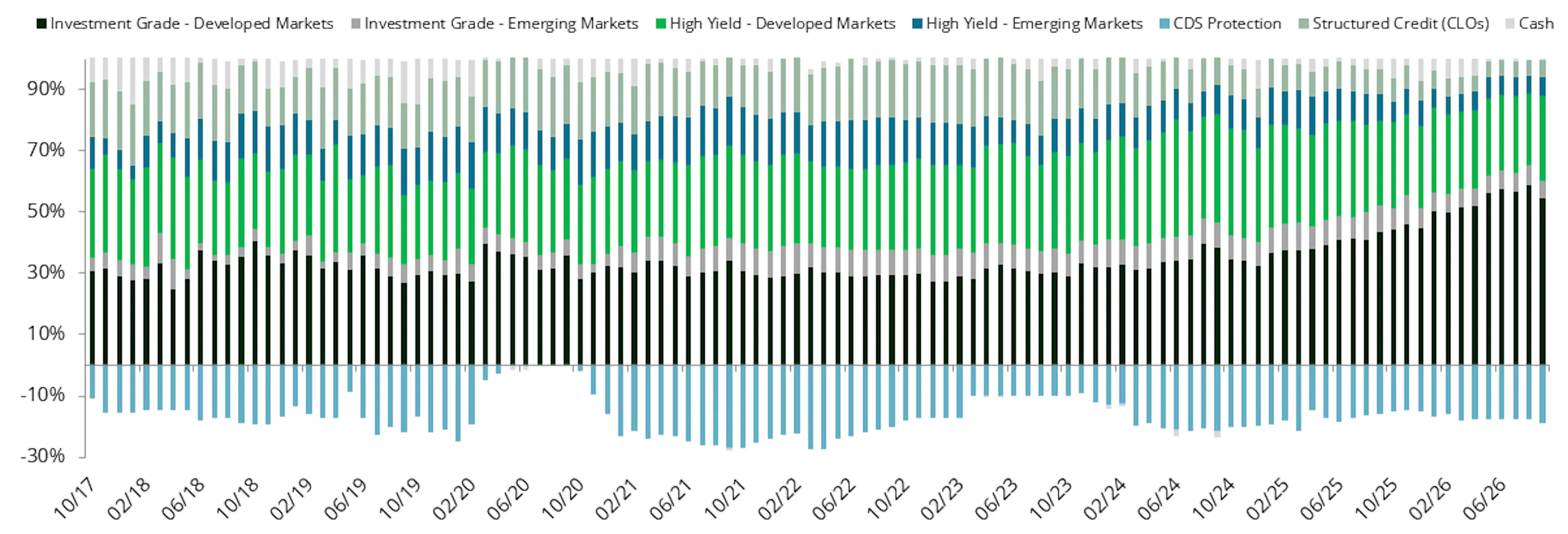
The Fund Management Team draw on a broad investment universe to dynamically shift allocation between defensive assets and more speculative segments depending on valuation levels. Over the past twelve months, this approach has resulted in gradual profit-taking on structured credit and High Yield exposures, while increasing allocations to Investment Grade issuers.
With net High Yield exposure now at only 15%, after credit index hedges -which represent approximately 18% of net assets, and with a preference for defensive carry assets, we believe the Fund is well positioned to withstand a potential further widening in credit spreads.
A more pronounced market correction would also create opportunities: the Fund would have the flexibility to reduce its hedges and progressively reallocate towards High Yield credit at more attractive valuation levels, allowing it to benefit from a potential subsequent market recovery.
At the end of September, the portfolio offered an embedded yield of 6.5%, compared with 5.7% at the beginning of the year, while maintaining an average Investment Grade rating of BBB- and an interest-rate sensitivity of 4.0. This combination of enhanced carry, defensive positioning and significant redeployment capacity leaves the Fund well positioned to navigate a more selective environment while retaining the flexibility to capitalise on future market dislocations.

Carmignac Portfolio Credit
Carmignac Portfolio Credit F USD Acc Hdg
- Recommended minimum investment horizon
- 3 years
- Risk indicator*
- 2/7
- SFDR - Fund Classification**
- Article 6
*Risk Scale from the KID (Key Information Document). Risk 1 does not mean a risk-free investment. This indicator may change over time. **Sustainable Finance Disclosure Regulation (SFDR) 2019/2088. The SFDR classification of the Funds may change over time.
Main risks of the fund
Fees
- Entry costs
- We do not charge an entry fee.
- Exit costs
- We do not charge an exit fee for this product.
- Management fees and other administrative or operating costs
- 0.80% of the value of your investment per year. This estimate is based on actual costs over the past year.
- Performance fees
- 20.00% when the share class overperforms the Reference indicator during the performance period. It will be payable also in case the share class has overperformed the reference indicator but had a negative performance. Underperformance is clawed back for 5 years. The actual amount will vary depending on how well your investment performs. The aggregated cost estimation above includes the average over the last 5 years, or since the product creation if it is less than 5 years.
- Transaction Cost
- 0.23% of the value of your investment per year. This is an estimate of the costs incurred when we buy and sell the investments underlying the product. The actual amount varies depending on the quantity we buy and sell.
Performance
| Carmignac Portfolio Credit | −0.4 | +8.8 | +9.9 | +12.6 | −11.3 | +3.9 | +12.3 | +2.8 |
| Reference Indicator | −0.9 | +3.6 | +5.7 | +9.0 | −13.3 | +0.1 | +2.8 | +0.1 |
| Carmignac Portfolio Credit | +8.1% | +3.5% | +5.1% |
| Reference Indicator | +4.6% | +0.4% | +0.7% |
Source: Carmignac at Sep 30, 2026.
Date of 1st NAV : 16/08/2019.
Past performance is not necessarily indicative of future performance. Performances are net of fees (excluding possible entrance fees charged by the distributor). The Fund presents a risk of loss of capital.
The return may increase or decrease as a result of currency fluctuations, for the shares which are not currency-hedged.
Reference Indicator: 75% ICE BofA Euro Corporate Index + 25% ICE BofA Euro High Yield index. Rebalancing Frequency: Quarterly
This document is issued by, or communicated on behalf of, Carmignac Middle East Ltd, a company incorporated under the laws of the Dubai International Financial Centre with company number CL 13413 registered at GD-PB-04-01-OF-01-0, Level 1, DIFC Fund Centre, Level POD, Gate District Precinct Building 04, Dubai International Financial Centre, Dubai, United Arab Emirates and regulated by the Dubai Financial Services Authority under reference number F013638.
This document is intended solely for Professional Clients and Market Counterparties, as defined under the applicable rules of the Dubai Financial Services Authority (“DFSA”). It must not be relied upon by, or distributed to, Retail Clients or any other person.
The fund(s) referred to in this document are foreign fund(s) domiciled and regulated in Luxembourg by the Commission de Surveillance du Secteur Financier (“CSSF”). Carmignac Portfolio refers to the sub-funds of Carmignac Portfolio SICAV, an investment company under Luxembourg law, conforming to the UCITS Directive. Carmignac Private Evergreen refers to the Private Evergreen sub-fund of the SICAV Carmignac S.A. SICAV – PART II UCI, registered with the Luxembourg RCS under number B285278. Unless expressly stated otherwise, they are not domiciled in, authorised by, or subject to regulation or approval by the DFSA. The DFSA has not approved, reviewed or verified this document, the prospectus or any other fund documentation, and the authority does not accept responsibility for the information contained in them or for the merits of an investment in the fund(s).
This document is provided for information purposes only. It does not constitute investment advice, a recommendation, or an offer or solicitation to buy or sell any financial instrument or fund interest. Any investment decision should be made solely on the basis of the applicable legal offering documents, including the prospectus and, where applicable, the key information document, and after obtaining independent professional advice as appropriate. The information contained in this material may be partial information and may be modified without prior notice. They are expressed as of the date of writing and are derived from proprietary and non-proprietary sources deemed by Carmignac to be reliable, are not necessarily all-inclusive and are not guaranteed as to accuracy. As such, no warranty of accuracy or reliability is given and no responsibility arising in any other way for errors and omissions (including responsibility to any person by reason of negligence) is accepted by Carmignac, its officers, employees or agents.
Access to the Funds may be subject to restrictions regarding certain persons or countries. This material is not directed to any person in any jurisdiction where (by reason of that person’s nationality, residence or otherwise) the material or availability of this material is prohibited. Persons in respect of whom such prohibitions apply must not access this material. Taxation depends on the situation of the individual. The Funds are not registered for retail distribution in Asia, in Japan, in North America, nor are they registered in South America. Carmignac Funds are registered in Singapore as restricted foreign scheme (for professional clients only). The Funds have not been registered under the US Securities Act of 1933. The Funds may not be offered or sold, directly or indirectly, for the benefit or on behalf of a «U.S. person», according to the definition of the US Regulation S and FATCA. The risks, fees and ongoing charges are described in the KID (Key Information Document). The KID must be made available to the subscriber prior to subscription. Prospective investors should read the fund's prospectus/KID and consult their own advisers before making any investment decision. Investors may lose some or all their capital, as the capital in the funds is not guaranteed.
Investment in the fund(s) involves risk, including possible loss of capital. The value of investments and income may go down as well as up, and investors may not recover the amount originally invested. Past performance is not a reliable indicator of future results. Performances are net of fees (excluding possible entrance fees charged by the distributor). The return may increase or decrease as a result of currency fluctuations, for the shares which are not currency-hedged. Any target, forecast, projection or forward-looking statement is based on assumptions and is not a guarantee of future performance or return.
Reference to certain securities and financial instruments is for illustrative purposes to highlight stocks that are or have been included in the portfolios of funds in the Carmignac range. This is not intended to promote direct investment in those instruments, nor does it constitute investment advice. The Management Company is not subject to prohibition on trading in these instruments prior to issuing any communication. The portfolios of Carmignac funds may change without previous notice.
The reference to a ranking or prize, is no guarantee of the future results of the UCITS or the manager.
Morningstar Rating™: © Morningstar, Inc. All Rights Reserved. The information contained herein: is proprietary to Morningstar and/or its content providers; may not be copied or distributed; and is not warranted to be accurate, complete or timely. Neither Morningstar nor its content providers are responsible for any damages or losses arising from any use of this information.
Funds classified as Article [8/9] products under the EU Sustainable Finance Disclosure Regulation (“SFDR”) are subject to an EU classification only, and does not represent a label, approval or endorsement by the Dubai Financial Services Authority or any UAE authority. Funds that pursue ESG related objectives alongside financial objectives do so without any guarantee that such ESG objectives will be achieved. ESG data and indicators may be based on third party sources, estimates and evolving methodologies and should not be viewed as a precise or comprehensive measure of sustainability performance.
The fund(s) may be subject to investment, market, liquidity, currency, credit, counterparty, concentration and other risks as described in the applicable offering documents. Prospective investors should conduct their own due diligence and carefully consider the risks, investment objectives, costs and suitability of an investment before making any decision.
The Management Company can cease promotion in your country anytime. Investors have access to a summary of their rights at section 5 entitled "summary of investor rights" at the following link: https://www.carmignac.com/en-ae/regulatory-information