
- In the United States, inflationary pressures remain structurally elevated, driven by expansionary fiscal policy, tariffs, labour market tensions and, more recently, higher energy prices. This combination increases the risk of inflation remaining persistently above the Federal Reserve’s (Fed) 2% target.
- In the euro area, the risk of stagflation is resurfacing: the energy shock is reigniting inflation at a time when growth is slowing, significantly limiting the room for manoeuvre of both the European Central Bank (ECB) and governments. Yet markets still appear to underestimate the risk of more persistent inflation.
- Inflationary risks could intensify further if tensions in the Middle East persist, given the region’s critical role in global energy flows, unfavourable base effects and the gradual pass-through of higher costs across the economy. The key risk is a potential de-anchoring of inflation expectations.
- This environment could nevertheless create opportunities for flexible fixed-income strategies, through inflation-linked bonds, inflation breakevens and nominal rate positions. These tools have contributed positively to Carmignac Portfolio Flexible Bond’s performance in 2026 and have historically been a significant source of performance for the strategy.
US inflation: devil inside
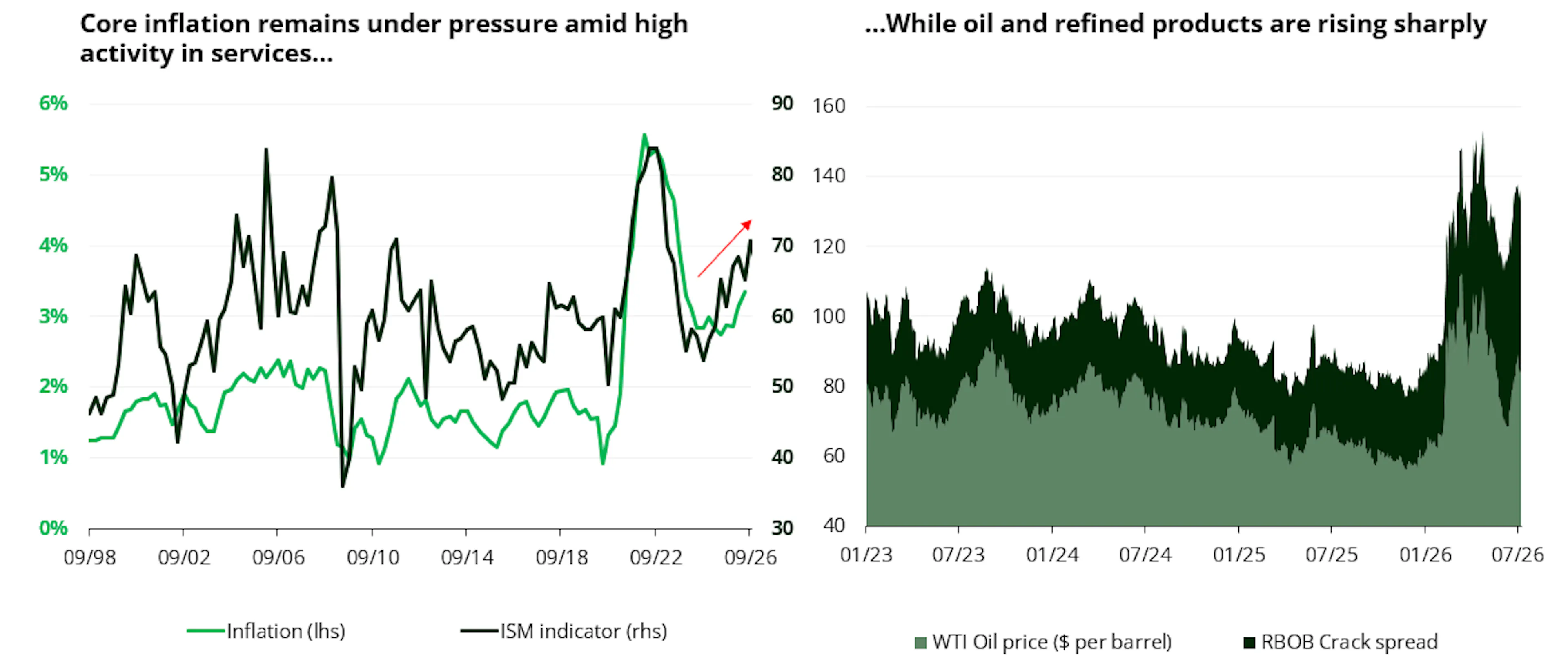
Consumer price data recorded the sharpest acceleration in three years in both April and May in the United States1, driven by the rebound in commodity prices observed since the beginning of the year. This development is more concerning given that core inflation, as measured by the PCE index, has remained above the Fed's 2% target for 63 consecutive months, with little tangible evidence suggesting a swift return to target.
Several imbalances lie behind these persistent inflationary pressures.
Firstly, the U.S. economy continues to benefit from exceptionally strong fiscal support. The various stimulus packages implemented under the Biden administration - notably the Inflation Reduction Act and the CHIPS Act - and subsequently reinforced by programs announced under Donald Trump, such as Stargate and the One Big Beautiful Bill Act, have sustained robust economic growth while supporting household purchasing power – albeit with some divergence in income categories. The highest income households and pensioners have also continued to benefit from significant wealth effects, fuelled by the strong performance of equity markets over recent years.
Secondly, the tariffs announced on "Liberation Day" on April 2, 2025, have begun to feed through to consumer prices. To date, they are estimated to have contributed nearly 0.82 percentage points to core PCE inflation. Such tariffs may be considered as transitory by most, yet this pass-through is expected to continue over the coming quarters, as companies have so far largely absorbed the shock through inventories accumulated before the implementation of the new tariff measures.
Finally, the immigration reforms introduced at the beginning of 2025, together with the intensification of deportations, have now resulted in negative net migration flows. This contraction in labour supply is expected to gradually exacerbate labour market tightness and reinforce wage pressures, with unemployment at 10 months lows and annual wage growth already standing at 3.4%3.
Against this backdrop, the Trump administration's military intervention in the Middle East has added further fuel to an inflationary dynamic that has already been building for several months. Admittedly, with the midterm elections approaching, the U.S. administration remains particularly sensitive to developments in gasoline prices, a highly visible variable for American consumers. The announcement of the gradual release of 172 million barrels from the Strategic Petroleum Reserve provides temporary relief at the pump and helps contain the immediate impact of the energy shock. Going forward, should geopolitical tensions persist, sustained high energy prices would likely lead to a broader transmission of inflationary pressures throughout the U.S. economy.
Conversely should some form of “deal” be agreed upon, strategic reserves will have to be reconstituted fuelling demand for the quarters ahead. Besides the blockade also means that gold is not the only reserve asset anymore. Commodities have re-entered the strategic playbook of governments worldwide. Such risks appear even more significant given that inflation transmission mechanisms were already well underway before the recent surge in oil prices.
Moreover, the Fed’s independence could come under increasing pressure in the years ahead. The new Federal Reserve Chair is operating in a political environment where expectations for a more accommodative monetary policy are likely to remain elevated, and where the boundaries between monetary and fiscal policy are increasingly being challenged, if not redefined. Beyond the fight against inflation, pressure could mount to maintain favourable financial conditions in order to finance investments related to artificial intelligence and growing fiscal deficits, support asset markets and, more broadly, preserve economic momentum.
In such an environment, the risk is that inflation becomes entrenched above the Fed's target, forcing policymakers to navigate an increasingly difficult trade-off between price stability, support for economic activity and financial stability.
Eurozone inflation: dead or alive?
Much like Schrödinger's cat, the nature of inflation in Europe remains difficult to determine with certainty. While inflation appeared to have been decisively subdued just six months ago, members of the ECB now seem increasingly concerned that the current energy shock could reignite the inflationary dynamics experienced three years ago. Such concerns are justified, as the euro area remains highly vulnerable to geopolitical events capable of disrupting global supply chains. The supply-chain dislocations triggered by the Covid-19 pandemic, combined with the commodity price shock following Russia's invasion of Ukraine in 2022, had already left lasting scars on the European economy. Against this backdrop, the escalation of tensions between the United States and Iran represents a new source of uncertainty, the temporary nature of the shock remains far from assured. Indeed, the succession of inflationary shocks in recent years may have made economic agents more sensitive to rising prices, increasing the risk that inflation expectations become more persistent and eventually de-anchor.
Inflation in the euro area has already reached 3.2% as of end of may4, its highest level since September 2023. Price pressures also appear to be spreading to core inflation, whose increase in May exceeded market expectations. Although underlying inflationary pressures remain significantly less concerning than in the United States, the ECB has limited room to contain potential second-round effects, particularly through a wage-price spiral, at a time when annual wage growth still stands at 3.0%5.
In a late-cycle European economy, the region's already modest growth outlook is likely to be further undermined by the Middle East conflict, with GDP growth expected to slow to just 0.8% this year. This weakness in economic activity will constrain the ECB's ability to maintain a restrictive monetary policy for an extended period. At the same time, governments have limited fiscal leeway to compensate for tighter monetary conditions, whether to support household purchasing power or sustain economic growth. Public deficits remain above the thresholds established by the Maastricht Treaty, while political instability across several major European economies continues to hinder the implementation of meaningful structural reforms.
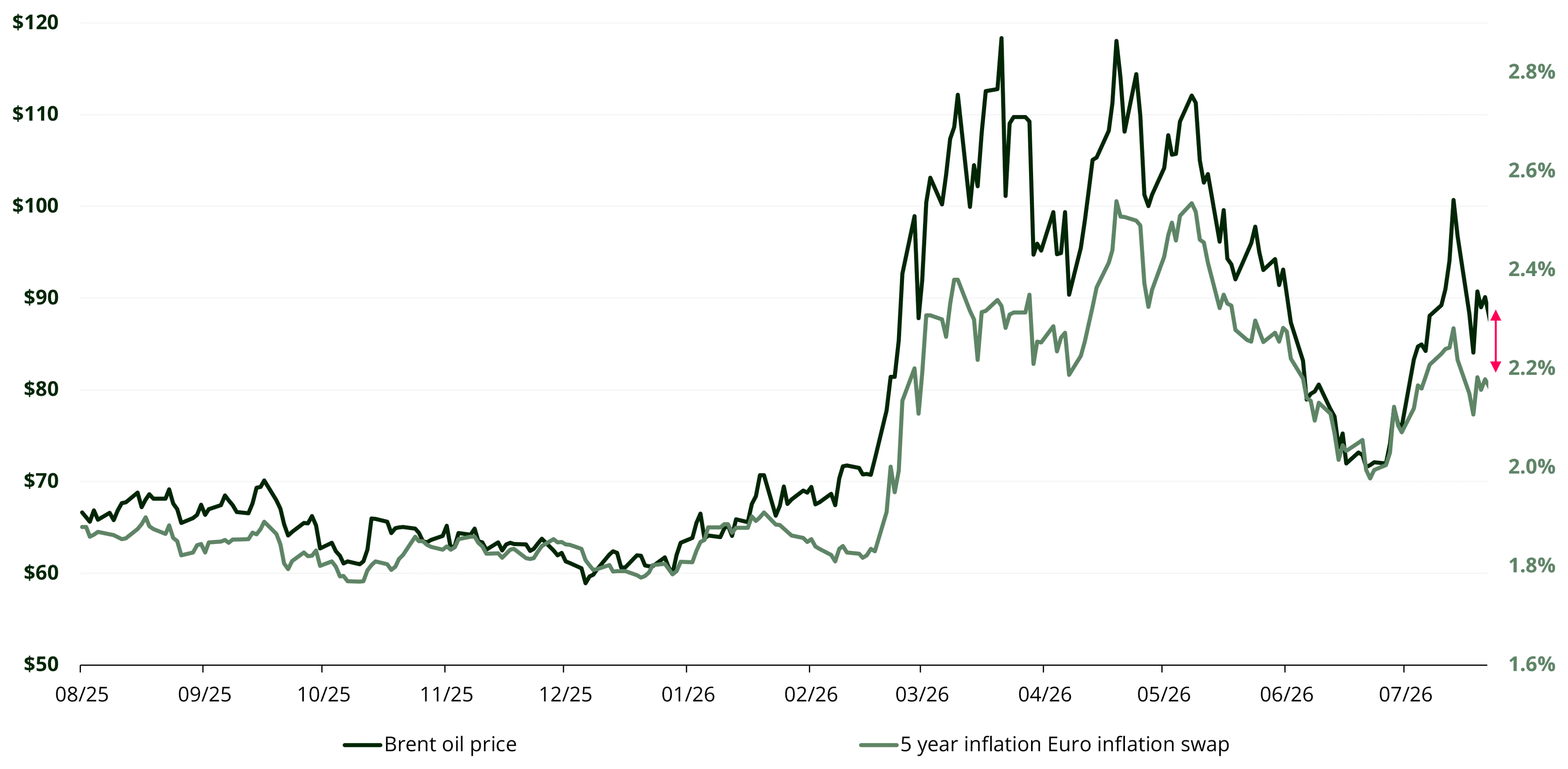
Against this backdrop, the spectre of stagflation is gradually re-emerging. Such an environment would be considerably more problematic—and potentially more persistent—than the inflationary episode of 2022–2023. Despite these challenging prospects, financial markets continue to anticipate a relatively rapid normalization of inflation. The two-year inflation breakeven currently stands at 2.6%, significantly below the 3.4% peak reached in mid-March. Five-year and ten-year inflation expectations are both trading at 2.2%6, only 20 basis points above the levels observed before the conflict. While a rapid normalization scenario remains plausible, markets still appear to assign only a limited probability to a less favourable outcome. At this stage, the risk of a more persistent inflation regime does not seem to be fully reflected in asset valuations.
Is the worst yet to come?
As geopolitical tensions continue to deepen in the Middle East, each additional day without a normalization of trade flows adds further pressure to the inflation outlook for the months ahead. Most forecasting models currently rely on energy price curves that mechanically incorporate a favourable backwardation structure, implying a gradual decline in energy prices over time. However, this assumption may prove overly optimistic should the current disruptions persist. Likewise, should the Strat of Hormuz reopen, the threat of renewed closure, of a toll being levied or growing insurance costs to adapt to new potential disruptions will keep prices higher than before the war.
In addition, base effects are likely to contribute to a mechanical reacceleration of inflation over the coming quarters. The sharp decline in commodity prices recorded during the second half of 2025, amid misplaced concerns over a slowdown in the U.S. economy, now provides a particularly “favourable” comparison base. As these effects gradually roll out of year-on-year calculations, inflation indicators are likely to display less favourable dynamics. These technical factors, combined with persistent investor optimism, help explain why U.S. inflation breakevens continue to trade more than one percentage point below the core PCE inflation rate recorded at the end of June (3.7%)7.
Such a divergence nevertheless appears difficult to justify, given that the transmission of the energy shock to the broader economy is still far from complete and that the duration of disruptions affecting the Strait of Hormuz remains one of the key uncertainties in the current macroeconomic outlook. Adding to this are the pressures affecting other agricultural commodities, which are facing particularly adverse weather conditions this year, notably linked to the “Super El Niño” phenomenon, as well as disruptions to fertilizer supplies originating in part from the Middle East.
Unlike the 2022 energy shock, which resulted from sanctions imposed on Russia, trade flows originating from the Middle East - particularly oil & gas - offer limited substitution possibilities in the short term. A significant share of global energy supply transits through this strategically important region and cannot easily be rerouted or rapidly replaced by alternative production capacity, the development of which may take years to materialize, whether through the opening of new energy fields or the expansion of renewable energy infrastructure. After several months of tensions and in the absence of tangible signs of improvement, the most prudent scenario is now to assume a prolonged disruption of energy supplies.
Such a development would likely translate into progressively higher production costs, initially affecting the most energy-intensive industries before gradually spreading across the broader economy through successive price increases.
The principal risk now lies in a gradual de-anchoring of inflation expectations. Such a development would occur at a time when major central banks have limited room to respond effectively to a renewed supply-side shock. With economic growth already weakening and inflation still above target, monetary authorities could find themselves facing particularly difficult trade-offs in the quarters ahead, forced once again to balance price stability against support for economic activity.
Rising inflation: challenge or opportunity for bond investors?
The prospect of a new inflationary wave, following the one experienced in 2022, could create opportunities for bond investors. Unlike traditional fixed-income approaches, flexible bond strategies possess a wide range of tools that enable them to navigate an environment that is less supportive of conventional fixed-income assets. Thanks to their broad investment universe, these strategies can invest in inflation-linked instruments while also adjusting the portfolio's overall interest rate sensitivity through short positions in bond markets. Indeed, a rise in inflation typically leads to higher nominal interest rates, which weighs on the valuation of traditional bonds by eroding the real returns perceived by investors.
Several strategies can be implemented to benefit from such an environment:
1Bureau of labor statistics, US CPI Urban Consumers over the last 12 months.
2Source: Federal Reserve, FEDS NOTE, 08/04/2026, Detecting Tariff Effects on Consumer Prices in Real Time – Part II.
3Average Hourly Earnings yearly change, 30/06/2026, Bureau of Labor Statistics.
4Euro Area Inflation All Items, Eurostat.
5Hourly labour costs in eurozone, % change compared with the same quarter of the previous year, calendar adjusted, end of Q1 2026, Eurostat.
6Bloomberg, as of 31/07/2026.
7U.S. headline Personal Consumption Expenditures (PCE), U.S. Bureau of Economic Analysis, 30/06/2026.
8Reference indicator: ICE BofA Euro Broad Market index.

Carmignac Portfolio Flexible Bond
Carmignac Portfolio Flexible Bond F USD Acc Hdg
- Recommended minimum investment horizon
- 3 years
- Risk indicator*
- 2/7
- SFDR - Fund Classification**
- Article 8
*Risk Scale from the KID (Key Information Document). Risk 1 does not mean a risk-free investment. This indicator may change over time. **Sustainable Finance Disclosure Regulation (SFDR) 2019/2088. The SFDR classification of the Funds may change over time.
Main risks of the fund
Fees
- Entry costs
- We do not charge an entry fee.
- Exit costs
- We do not charge an exit fee for this product.
- Management fees and other administrative or operating costs
- 0.77% of the value of your investment per year. This estimate is based on actual costs over the past year.
- Performance fees
- 20.00% when the share class overperforms the Reference indicator during the performance period. It will be payable also in case the share class has overperformed the reference indicator but had a negative performance. Underperformance is clawed back for 5 years. The actual amount will vary depending on how well your investment performs. The aggregated cost estimation above includes the average over the last 5 years, or since the product creation if it is less than 5 years.
- Transaction Cost
- 0.20% of the value of your investment per year. This is an estimate of the costs incurred when we buy and sell the investments underlying the product. The actual amount varies depending on the quantity we buy and sell.
Performance
| Carmignac Portfolio Flexible Bond | +3.2 | +6.5 | +6.3 | +6.8 | −6.2 |
| Reference Indicator | −0.2 | +1.3 | +2.6 | +6.8 | −16.9 |
| Carmignac Portfolio Flexible Bond | +4.0% | +6.7% | +3.5% |
| Reference Indicator | +0.2% | +2.8% | −1.8% |
Source: Carmignac at Jul 31, 2026.
Date of 1st NAV : 31/12/2021.
Past performance is not necessarily indicative of future performance. Performances are net of fees (excluding possible entrance fees charged by the distributor). The Fund presents a risk of loss of capital.
The return may increase or decrease as a result of currency fluctuations, for the shares which are not currency-hedged.
Reference Indicator: ICE BofA Euro Broad Market index
This document is issued by, or communicated on behalf of, Carmignac Middle East Ltd, a company incorporated under the laws of the Dubai International Financial Centre with company number CL 13413 registered at GD-PB-04-01-OF-01-0, Level 1, DIFC Fund Centre, Level POD, Gate District Precinct Building 04, Dubai International Financial Centre, Dubai, United Arab Emirates and regulated by the Dubai Financial Services Authority under reference number F013638.
This document is intended solely for Professional Clients and Market Counterparties, as defined under the applicable rules of the Dubai Financial Services Authority (“DFSA”). It must not be relied upon by, or distributed to, Retail Clients or any other person.
The fund(s) referred to in this document are foreign fund(s) domiciled and regulated in Luxembourg by the Commission de Surveillance du Secteur Financier (“CSSF”). Carmignac Portfolio refers to the sub-funds of Carmignac Portfolio SICAV, an investment company under Luxembourg law, conforming to the UCITS Directive. Carmignac Private Evergreen refers to the Private Evergreen sub-fund of the SICAV Carmignac S.A. SICAV – PART II UCI, registered with the Luxembourg RCS under number B285278. Unless expressly stated otherwise, they are not domiciled in, authorised by, or subject to regulation or approval by the DFSA. The DFSA has not approved, reviewed or verified this document, the prospectus or any other fund documentation, and the authority does not accept responsibility for the information contained in them or for the merits of an investment in the fund(s).
This document is provided for information purposes only. It does not constitute investment advice, a recommendation, or an offer or solicitation to buy or sell any financial instrument or fund interest. Any investment decision should be made solely on the basis of the applicable legal offering documents, including the prospectus and, where applicable, the key information document, and after obtaining independent professional advice as appropriate. The information contained in this material may be partial information and may be modified without prior notice. They are expressed as of the date of writing and are derived from proprietary and non-proprietary sources deemed by Carmignac to be reliable, are not necessarily all-inclusive and are not guaranteed as to accuracy. As such, no warranty of accuracy or reliability is given and no responsibility arising in any other way for errors and omissions (including responsibility to any person by reason of negligence) is accepted by Carmignac, its officers, employees or agents.
Access to the Funds may be subject to restrictions regarding certain persons or countries. This material is not directed to any person in any jurisdiction where (by reason of that person’s nationality, residence or otherwise) the material or availability of this material is prohibited. Persons in respect of whom such prohibitions apply must not access this material. Taxation depends on the situation of the individual. The Funds are not registered for retail distribution in Asia, in Japan, in North America, nor are they registered in South America. Carmignac Funds are registered in Singapore as restricted foreign scheme (for professional clients only). The Funds have not been registered under the US Securities Act of 1933. The Funds may not be offered or sold, directly or indirectly, for the benefit or on behalf of a «U.S. person», according to the definition of the US Regulation S and FATCA. The risks, fees and ongoing charges are described in the KID (Key Information Document). The KID must be made available to the subscriber prior to subscription. Prospective investors should read the fund's prospectus/KID and consult their own advisers before making any investment decision. Investors may lose some or all their capital, as the capital in the funds is not guaranteed.
Investment in the fund(s) involves risk, including possible loss of capital. The value of investments and income may go down as well as up, and investors may not recover the amount originally invested. Past performance is not a reliable indicator of future results. Performances are net of fees (excluding possible entrance fees charged by the distributor). The return may increase or decrease as a result of currency fluctuations, for the shares which are not currency-hedged. Any target, forecast, projection or forward-looking statement is based on assumptions and is not a guarantee of future performance or return.
Reference to certain securities and financial instruments is for illustrative purposes to highlight stocks that are or have been included in the portfolios of funds in the Carmignac range. This is not intended to promote direct investment in those instruments, nor does it constitute investment advice. The Management Company is not subject to prohibition on trading in these instruments prior to issuing any communication. The portfolios of Carmignac funds may change without previous notice.
The reference to a ranking or prize, is no guarantee of the future results of the UCITS or the manager.
Morningstar Rating™: © Morningstar, Inc. All Rights Reserved. The information contained herein: is proprietary to Morningstar and/or its content providers; may not be copied or distributed; and is not warranted to be accurate, complete or timely. Neither Morningstar nor its content providers are responsible for any damages or losses arising from any use of this information.
Funds classified as Article [8/9] products under the EU Sustainable Finance Disclosure Regulation (“SFDR”) are subject to an EU classification only, and does not represent a label, approval or endorsement by the Dubai Financial Services Authority or any UAE authority. Funds that pursue ESG related objectives alongside financial objectives do so without any guarantee that such ESG objectives will be achieved. ESG data and indicators may be based on third party sources, estimates and evolving methodologies and should not be viewed as a precise or comprehensive measure of sustainability performance.
The fund(s) may be subject to investment, market, liquidity, currency, credit, counterparty, concentration and other risks as described in the applicable offering documents. Prospective investors should conduct their own due diligence and carefully consider the risks, investment objectives, costs and suitability of an investment before making any decision.
The Management Company can cease promotion in your country anytime. Investors have access to a summary of their rights at section 5 entitled "summary of investor rights" at the following link: https://www.carmignac.com/en-ae/regulatory-information