
Emerging markets are defined by high dispersion, structural inefficiency and information asymmetry. For active managers, these are features that can be exploited. For passive investors, they are a problem that an index fund cannot solve.
Emerging markets delivered their strongest annual return since 2017 in 2025. The headline figure was impressive but what lay beneath could be more instructive.
Korea surged 97% in US dollar terms, South Africa rose 73%, Mexico gained 50% and Brazil 40%. Meanwhile, Saudi Arabia, Indonesia, Argentina and the Philippines all posted negative returns for the year. The same asset class in the same calendar year, but outcomes separated by more than 100 percentage points1.
That dispersion is not a quirk of 2025 but a common characteristic of emerging markets as an asset class. And it is the most straightforward argument against passive exposure: buying the index means buying all of it, the leaders and the laggards, without the ability to distinguish between them.
What passive emerging market exposure actually gives you
Emerging market indices are constructed by market capitalisation, which means they systematically overweight whatever has already performed well and underweight what has not yet been recognised. By the time a company becomes large enough to warrant meaningful index weight, much of its return has already been captured by those who identified it earlier. In a sense, the passive investor arrives late.
According to Naomi Waistell, co-fund manager of Carmignac Portfolio Emergents: "Performance benchmarks are really backward looking barometers of performance rather than telling us about how we want to position for the future."
The construction problem runs deeper than timing. Passive strategies in emerging markets include state-owned enterprises whose objectives often diverge from those of minority shareholders, companies with governance ratings at the bottom of the scale and businesses on exclusion lists for weapons manufacturing, coal extraction or regulatory violations.
An index fund cannot screen any of these out but an active manager can and arguably must.
The inability to respond when an investment case changes is equally costly. When Samsung Electronics failed to obtain Nvidia certification for its most advanced memory chips, its competitive position in the high-bandwidth memory market deteriorated materially but an index fund continued to hold the stock at its market-cap weight.
An active manager who identified the shift in competitive dynamics could exit the position and redeploy into SK Hynix, which had the technological lead and Nvidia’s qualification. And when Samsung obtained the certification active managers could then reinitiate a position in the stock. That was a real-life example that drove some of Carmignac Portfolio Emergents’ recent outperformance.
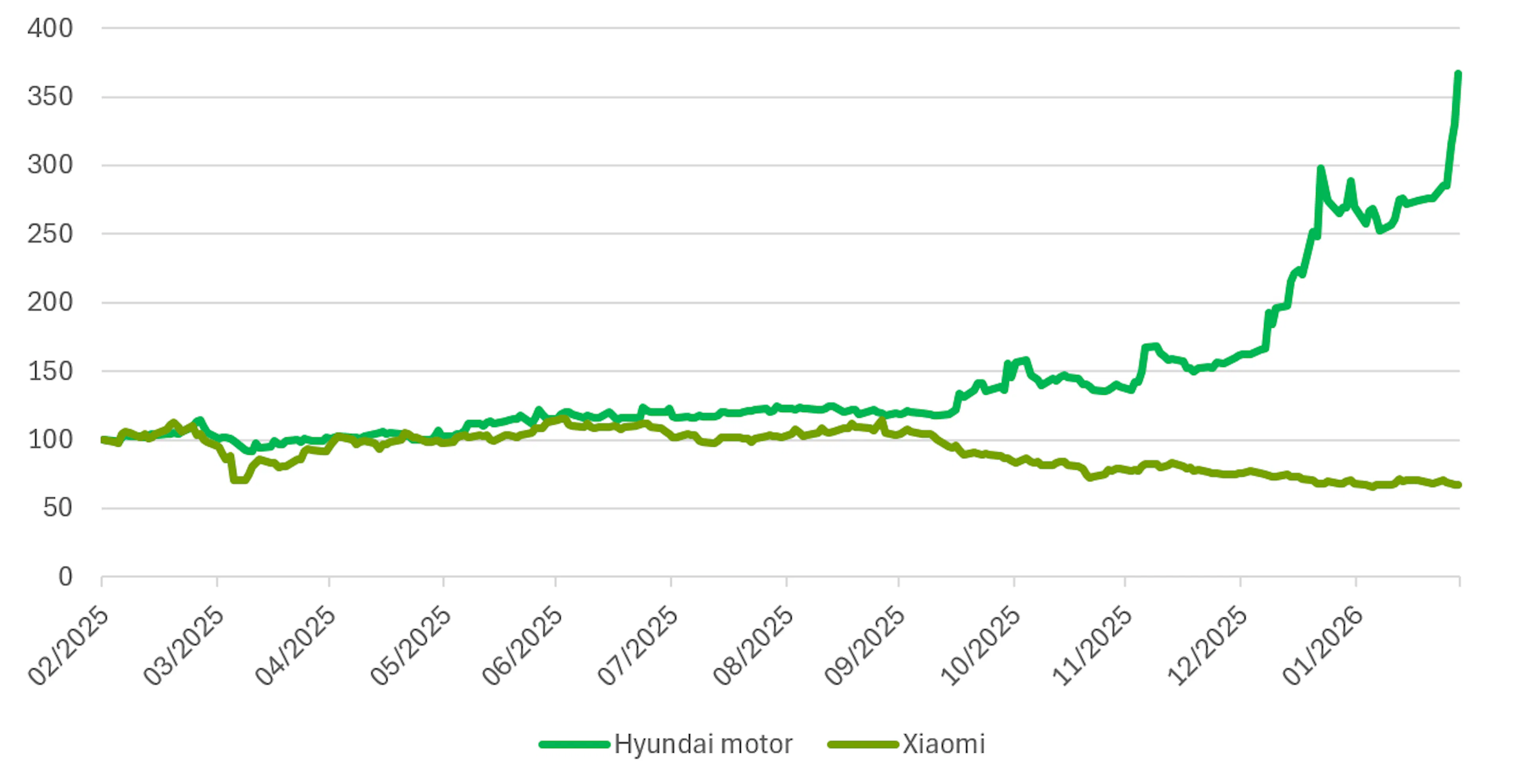
A similar dynamic can be observed in the automotive sector. In emerging market indices, Xiaomi has rapidly become one of the largest auto-related weights following the market’s enthusiasm around its entry into electric vehicles. From a passive perspective, its growing market capitalisation automatically translates into a higher index allocation.
However, an active approach leads to a different conclusion. Rather than following index weights, we prefer companies where fundamentals and long-term competitive advantages appear stronger. In this case, we favour Hyundai. Beyond its established automotive business, Hyundai is investing heavily in robotics through its participation in Boston Dynamics, a technological capability that we believe could meaningfully enhance productivity and strengthen its competitive positioning over time.
The performance divergence illustrates the value of this approach. Over the rolling twelve months to the end of February 2026, Hyundai — which we hold in the portfolio — delivered a return of +267%, while Xiaomi declined by -33% over the same period.
This type of dispersion highlights why fundamental research and active decision-making matter in emerging markets: the largest weight in the index is not necessarily the most compelling investment opportunity.
Why emerging markets specifically reward active management
The conditions that make passive strategies attractive in developed markets, namely high liquidity, standardised disclosure, efficient price discovery and relatively uniform governance, are substantially less prevalent in emerging markets. Information asymmetry is higher, financial statements are sometimes non-standardised and local dynamics require on-the-ground knowledge that cannot be derived from a screen.
Waistell describes these conditions not as obstacles but as sources of opportunity: "Emerging markets are volatile by nature. They always have been. And sometimes we can actually use that volatility, the extra inefficiencies in emerging markets to our advantage when we're investing."
Carmignac Portfolio Emergents co-fund manager Xavier Hovasse added: "In emerging markets, there's a lot of volatility and sometimes stocks go up way too much. So, we take that opportunity to trim or they go down way too much, which is an opportunity to buy more at a very good price."
The cost of getting country and sector allocation wrong in emerging markets is also substantially higher than in developed markets, where broad economic trends tend to lift all boats to a similar degree. In emerging markets, country selection alone can swing returns by a substantial margin, as 2025 demonstrated.
Hovasse, who is Carmignac’s Head of Emerging Equities, said: "When you invest in emerging markets, both top down and bottom up are very important. In terms of the chronology, you start with the top-down thinking. You need to find the best countries, the best sectors, the best businesses, and only after that you need to try to find the best vehicles to play that."
The shift from beta to alpha
The 2025 emerging market equity rally was primarily beta-driven. As macro conditions improved and investor sentiment turned positive, price/earnings multiples expanded across the asset class. Broad exposure worked because everything was rising.
The next phase could be different. With emerging markets now trading at around 12.5x forward 2026 earnings, elevated relative to recent history, further multiple expansion is less certain. Emerging market equities are forecast to deliver mid-to-high-teens EPS growth in 2026 and returns from here are more likely to be determined by which companies actually deliver the expected earnings than by a broad re-rating of the asset class2.
Waistell elaborated: "A weaker US dollar, historically high real rates and stable inflation provide EM central banks with room to gradually ease monetary policy, creating meaningful tailwinds. However, we are entering a phase of rising dispersion, where returns are likely to be driven more by earnings growth than multiple expansion, making selectivity more important than index exposure."
How Carmignac approaches the opportunity
Carmignac Portfolio Emergents is a direct counterpoint to passive exposure. The portfolio holds 35-45 stocks, selected through a combination of top-down country and sector analysis and rigorous bottom-up stock picking. Active share stood at 80% as of end-March 2026, meaning the portfolio is substantially different from the reference indicator it is measured against.
The fund managers also work closely with a dedicated Front Office Risk Management team to better understand the portfolio’s sensitivity to different market variables, for example by assessing its sensitivity to oil prices, US real rates and to a value vs growth bias. Understanding these underlying sensitivity and bases of the fund enables the fund managers to make more informed investment decisions and adjust the portfolio if needed and illustrates the value added by active management compared with passive strategies.
Sustainability is integrated as an investment discipline rather than a constraint. As Waistell explained: "We think that sustainability is actually value accretive and alpha seeking in its own right. We're just putting more information, more fundamental analysis into stock prices upfront."
Since the fund's launch in February 1997, it has returned 893%3 against a reference indicator return of 285%4, net of fees as at the end of March 2026.
Waistell concludes: “The other thing that's key is to have a clear process and follow that process through the long term. That avoids being buffeted by some of the short-term factors. Yes, we can be agile if we need to and make bold decisions when that's called for, but ultimately what we're trying to do is drive the best risk-adjusted returns.”
1Source: Bloomberg, MSCI, 31/12/2025.
2Sources: Carmignac, CLSA Research, Bloomberg, 12/01/2026.
3Performance of Carmignac Emergents A EUR Acc.
4Reference Indicator: MSCI EM NR index.

Carmignac Portfolio Emergents
Carmignac Portfolio Emergents F USD Acc Hdg
- Recommended minimum investment horizon
- 5 years
- Risk indicator*
- 4/7
- SFDR - Fund Classification**
- Article 9
*Risk Scale from the KID (Key Information Document). Risk 1 does not mean a risk-free investment. This indicator may change over time. **Sustainable Finance Disclosure Regulation (SFDR) 2019/2088. The SFDR classification of the Funds may change over time.
Main risks of the fund
Fees
- Entry costs
- We do not charge an entry fee.
- Exit costs
- We do not charge an exit fee for this product.
- Management fees and other administrative or operating costs
- 1.15% of the value of your investment per year. This estimate is based on actual costs over the past year.
- Performance fees
- 20.00% when the share class overperforms the Reference indicator during the performance period. It will be payable also in case the share class has overperformed the reference indicator but had a negative performance. Underperformance is clawed back for 5 years. The actual amount will vary depending on how well your investment performs. The aggregated cost estimation above includes the average over the last 5 years, or since the product creation if it is less than 5 years.
- Transaction Cost
- 0.39% of the value of your investment per year. This is an estimate of the costs incurred when we buy and sell the investments underlying the product. The actual amount varies depending on the quantity we buy and sell.
Performance
| Carmignac Portfolio Emergents | +2.4 | +25.9 | +6.8 | +11.3 | −13.0 | −9.6 | +47.1 | +28.2 | −16.0 | +21.9 |
| Reference Indicator | +1.8 | +17.8 | +14.7 | +6.1 | −14.9 | +4.9 | +8.5 | +20.6 | −10.3 | +20.6 |
| Carmignac Portfolio Emergents | +13.3% | +3.2% | +9.2% |
| Reference Indicator | +12.6% | +4.1% | +7.7% |
Source: Carmignac at Mar 31, 2026.
Past performance is not necessarily indicative of future performance. Performances are net of fees (excluding possible entrance fees charged by the distributor). The Fund presents a risk of loss of capital.
The return may increase or decrease as a result of currency fluctuations, for the shares which are not currency-hedged.
Reference Indicator: MSCI EM NR index
This document is issued by, or communicated on behalf of, Carmignac Middle East Ltd, a company incorporated under the laws of the Dubai International Financial Centre with company number CL 13413 registered at GD-PB-04-01-OF-01-0, Level 1, DIFC Fund Centre, Level POD, Gate District Precinct Building 04, Dubai International Financial Centre, Dubai, United Arab Emirates and regulated by the Dubai Financial Services Authority under reference number F013638.
This document is intended solely for Professional Clients and Market Counterparties, as defined under the applicable rules of the Dubai Financial Services Authority (“DFSA”). It must not be relied upon by, or distributed to, Retail Clients or any other person.
The fund(s) referred to in this document are foreign fund(s) domiciled and regulated in Luxembourg by the Commission de Surveillance du Secteur Financier (“CSSF”). Carmignac Portfolio refers to the sub-funds of Carmignac Portfolio SICAV, an investment company under Luxembourg law, conforming to the UCITS Directive. Carmignac Private Evergreen refers to the Private Evergreen sub-fund of the SICAV Carmignac S.A. SICAV – PART II UCI, registered with the Luxembourg RCS under number B285278. Unless expressly stated otherwise, they are not domiciled in, authorised by, or subject to regulation or approval by the DFSA. The DFSA has not approved, reviewed or verified this document, the prospectus or any other fund documentation, and the authority does not accept responsibility for the information contained in them or for the merits of an investment in the fund(s).
This document is provided for information purposes only. It does not constitute investment advice, a recommendation, or an offer or solicitation to buy or sell any financial instrument or fund interest. Any investment decision should be made solely on the basis of the applicable legal offering documents, including the prospectus and, where applicable, the key information document, and after obtaining independent professional advice as appropriate. The information contained in this material may be partial information and may be modified without prior notice. They are expressed as of the date of writing and are derived from proprietary and non-proprietary sources deemed by Carmignac to be reliable, are not necessarily all-inclusive and are not guaranteed as to accuracy. As such, no warranty of accuracy or reliability is given and no responsibility arising in any other way for errors and omissions (including responsibility to any person by reason of negligence) is accepted by Carmignac, its officers, employees or agents.
Access to the Funds may be subject to restrictions regarding certain persons or countries. This material is not directed to any person in any jurisdiction where (by reason of that person’s nationality, residence or otherwise) the material or availability of this material is prohibited. Persons in respect of whom such prohibitions apply must not access this material. Taxation depends on the situation of the individual. The Funds are not registered for retail distribution in Asia, in Japan, in North America, nor are they registered in South America. Carmignac Funds are registered in Singapore as restricted foreign scheme (for professional clients only). The Funds have not been registered under the US Securities Act of 1933. The Funds may not be offered or sold, directly or indirectly, for the benefit or on behalf of a «U.S. person», according to the definition of the US Regulation S and FATCA. The risks, fees and ongoing charges are described in the KID (Key Information Document). The KID must be made available to the subscriber prior to subscription. Prospective investors should read the fund's prospectus/KID and consult their own advisers before making any investment decision. Investors may lose some or all their capital, as the capital in the funds is not guaranteed.
Investment in the fund(s) involves risk, including possible loss of capital. The value of investments and income may go down as well as up, and investors may not recover the amount originally invested. Past performance is not a reliable indicator of future results. Performances are net of fees (excluding possible entrance fees charged by the distributor). The return may increase or decrease as a result of currency fluctuations, for the shares which are not currency-hedged. Any target, forecast, projection or forward-looking statement is based on assumptions and is not a guarantee of future performance or return.
Reference to certain securities and financial instruments is for illustrative purposes to highlight stocks that are or have been included in the portfolios of funds in the Carmignac range. This is not intended to promote direct investment in those instruments, nor does it constitute investment advice. The Management Company is not subject to prohibition on trading in these instruments prior to issuing any communication. The portfolios of Carmignac funds may change without previous notice.
The reference to a ranking or prize, is no guarantee of the future results of the UCITS or the manager.
Morningstar Rating™: © Morningstar, Inc. All Rights Reserved. The information contained herein: is proprietary to Morningstar and/or its content providers; may not be copied or distributed; and is not warranted to be accurate, complete or timely. Neither Morningstar nor its content providers are responsible for any damages or losses arising from any use of this information.
Funds classified as Article [8/9] products under the EU Sustainable Finance Disclosure Regulation (“SFDR”) are subject to an EU classification only, and does not represent a label, approval or endorsement by the Dubai Financial Services Authority or any UAE authority. Funds that pursue ESG related objectives alongside financial objectives do so without any guarantee that such ESG objectives will be achieved. ESG data and indicators may be based on third party sources, estimates and evolving methodologies and should not be viewed as a precise or comprehensive measure of sustainability performance.
The fund(s) may be subject to investment, market, liquidity, currency, credit, counterparty, concentration and other risks as described in the applicable offering documents. Prospective investors should conduct their own due diligence and carefully consider the risks, investment objectives, costs and suitability of an investment before making any decision.
The Management Company can cease promotion in your country anytime. Investors have access to a summary of their rights at section 5 entitled "summary of investor rights" at the following link: https://www.carmignac.com/en-ae/regulatory-information