
Recent years have challenged a widely accepted assumption: the idea of “natural” diversification across asset classes. In 2022, and more recently amid tensions in the Middle East, equities and bonds declined simultaneously, reminding investors that a portfolio may appear diversified… yet still move in lockstep when markets come under stress.
Today, diversification is no longer simply about allocating between equities and bonds. Many assets now react similarly to common drivers such as inflation expectations, monetary policy shifts, and growth outlooks. In this context, effective diversification requires a more demanding approach: combining genuinely differentiated sources of return that can withstand a range of market environments. These are the principles that guide our diversification strategy within the Carmignac Patrimoine Fund.
Safe-Haven Assets Are Not Infallible
The defensive nature of a so-called “safe haven” asset works under certain economic conditions. In other words, no asset provides permanent protection, it all depends on how investors are positioned within the macroeconomic environment. As these conditions evolve, so too does the behaviour of safe-haven assets.

Gold: A Changing Safe Haven
Traditionally seen as the ultimate safe-haven asset, gold has deviated from this role in recent years.
Following a solid 2024 and an exceptional 2025 (+64%1), gold entered a near-parabolic phase at the start of 2026.
As a non-industrial asset with an inconsistent relationship to both inflation and the economic cycle, gold lends itself to a wide range of narratives: de-dollarisation, fiscal slippage, geopolitical fragmentation, or even more exogenous factors. In this environment, the yellow metal has at times behaved more like a growth asset than a defensive one.
The outbreak of the Iranian conflict reshuffled the deck, triggering a marked decline in gold prices, contrary to its traditional role as a hedge during geopolitical stress. We believe this disconnect can be explained by several concurrent factors: highly crowded positioning, significant profit-taking, rising real yields, and reduced support from Middle Eastern central banks. These developments highlight the increasingly complex role of gold in portfolios, particularly when valuations become stretched.
Within Carmignac Patrimoine, we adopt an active approach. For instance, in response to identified momentum risk in gold, we significantly reduced our exposure to gold mining equities from around 3% at the end of 2025 to 0.5% in March 20262.

Rising Yields: A New Source of Risk
Bonds have long been the primary stabilizer in diversified portfolios. However, this paradigm has been fundamentally challenged since 2022, in an environment where the correlation between equities and rates has deteriorated significantly.
Since the outbreak of the Iranian conflict, rising yields have reflected a broader reassessment of inflation and risk premia. The geopolitical shock initially acted as an energy supply shock, driving oil prices higher and increasing supply chain volatility, thereby reigniting inflationary pressures that central banks had not fully anchored. As a result, medium-term inflation expectations have been revised upward, mechanically pushing both real and inflation components of long-term yields higher.
At the same time, this shock comes against the backdrop of already constrained fiscal conditions, with elevated levels of public debt. It has further increased sovereign issuance needs, particularly in Europe, adding additional upward pressure on long-term yields.
This market environment underscores that diversification can no longer rely on supposedly stable structural relationships.
Within Carmignac Patrimoine, modified duration is managed flexibly, ranging from a range of -4 to +10, and represents a genuine source of diversification. At the beginning of 2026, we adopted negative duration to protect the portfolio in an environment of persistent inflation and robust growth, particularly in the United States. This positioning proved effective in March amid the Iran crisis.
Maintaining Independence from Market Consensus
In uncertain environments, market consensus can quickly become a source of risk. Our approach combines exposure to prevailing market trends (“momentum”) with more differentiated convictions derived from our macroeconomic and fundamental analysis.
For example, we maintain meaningful exposure to the technology sector while implementing targeted reallocations. Alongside positions in the semiconductor value chain, we reduced exposure to hyperscalers in favour of software companies, taking advantage of a sharp correction in the segment and what we believe to be excessively pessimistic market expectations relative to fundamentals. Initiated ahead of tensions related to the Iran conflict, this contrarian positioning materialized more quickly than expected, as renewed geopolitical risk accelerated the normalization of overly depressed valuations.
In addition, our conviction that inflation would prove more persistent than markets anticipated led us to incorporate inflation-linked instruments as early as 2024, well before recent geopolitical developments. This positioning aimed to hedge against a repricing of inflation expectations in a context marked by fiscal imbalances, sustained growth, and structural factors such as demographic trends and the reconfiguration of supply chains.
More broadly, this investment discipline reflects our commitment to building robust portfolios capable of withstanding multiple market regimes, avoiding consensus biases, and continuously seeking true sources of diversification.
Leveraging Geographic Diversification
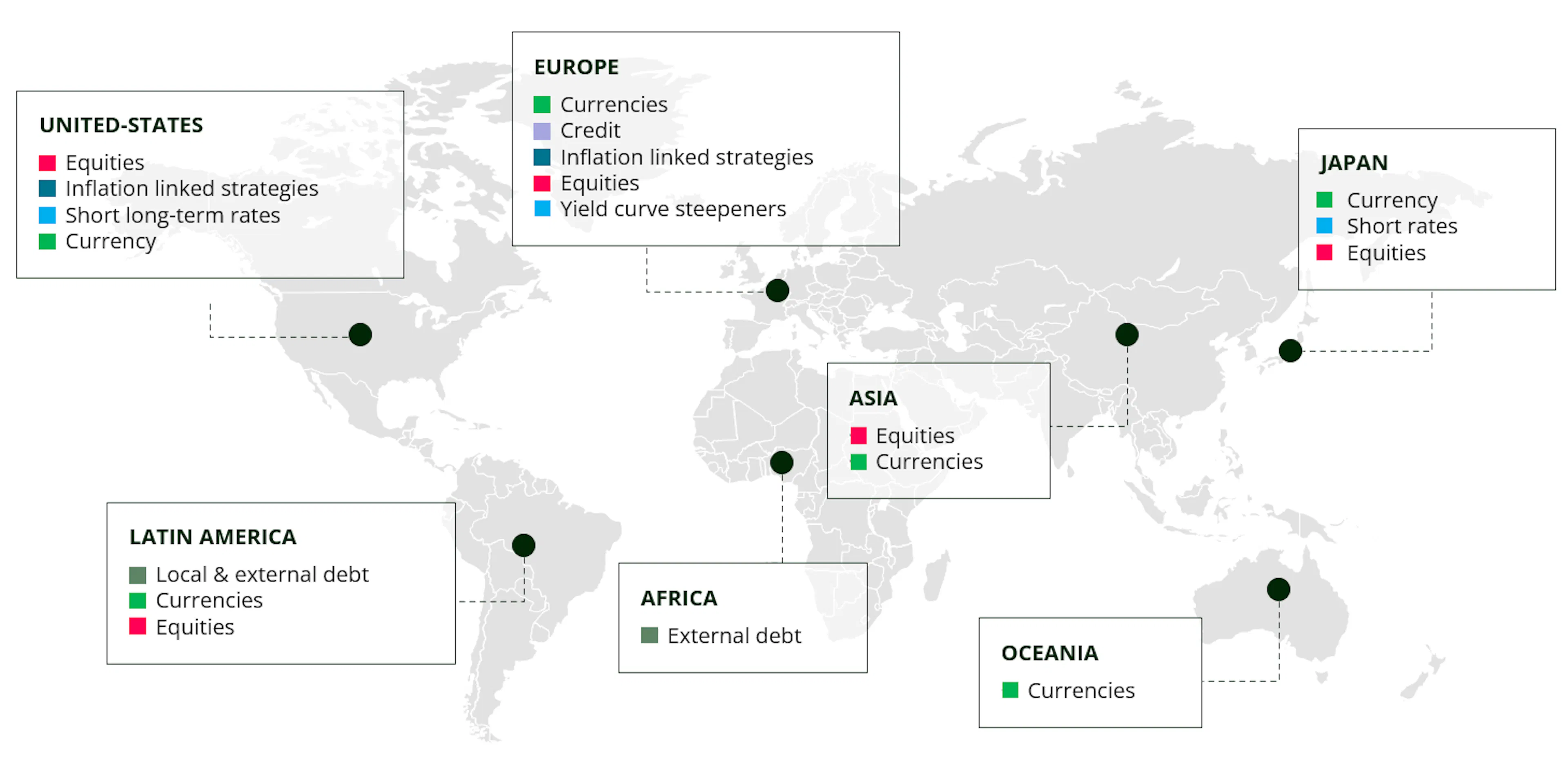
Diversification also relies on active geographic allocation. Economic cycles, monetary policies, and sector dynamics vary significantly across regions. Within Carmignac Patrimoine, our allocation goes beyond a static regional split. It is based on a granular assessment of opportunities, enabling us to identify, within each region, the most relevant asset classes to express a given investment theme.
Take commodities as an example. Our scenario of structurally higher inflation supports a constructive allocation to this theme. However, this exposure is not systematically implemented through equities. Instead, we have chosen to express this conviction through currencies of countries we consider closely linked to commodity cycles, such as the Brazilian real and the Australian dollar. This is precisely what geographic diversification means: leveraging the full breadth of market instruments to select the most appropriate vehicles for expressing an investment view.
Buying Protection When It Is Cheap
No one would consider taking out home insurance once their house is already on fire, it would simply be too late. Yet in financial markets, this behavior is common: investors neglect protection in calm periods, only to rush into options during market stress… precisely when they are most expensive and least effective.
Derivatives, and options in particular, can be highly effective provided they are used at the right time and with a clear understanding of their risks. Within Carmignac Patrimoine, the investment team favors their use during periods of low volatility, when we consider risks to be underpriced and the convexity they offer is attractive ; that is, when the trade-off between upfront cost and potential protection is favorable.
These instruments can be deployed across asset classes, including equities, rates, currencies, and volatility, with the aim of limiting the impact of large adverse market movements on portfolio performance.
Case Study: CDS, our 2026 Insurance
1Source: Bloomberg, 31/12/2025.
2Source: Carmignac, as of 27/03/2026.

Carmignac Patrimoine
Carmignac Patrimoine A EUR Acc
- Recommended minimum investment horizon
- 3 years
- Risk indicator*
- 3/7
- SFDR - Fund Classification**
- Article 8
*Risk Scale from the KID (Key Information Document). Risk 1 does not mean a risk-free investment. This indicator may change over time. **Sustainable Finance Disclosure Regulation (SFDR) 2019/2088. The SFDR classification of the Funds may change over time.
Main risks of the fund
Fees
- Entry costs
- 4.00% of the amount you pay in when entering this investment. This is the most you will be charged. Carmignac Gestion doesn't charge any entry fee. The person selling you the product will inform you of the actual charge.
- Exit costs
- We do not charge an exit fee for this product.
- Management fees and other administrative or operating costs
- 1.80% of the value of your investment per year. This estimate is based on actual costs over the past year.
- Performance fees
- 20.00% max. of the outperformance once performance since the start of the year exceeds that of the reference indicator and if no past underperformance still needs to be offset. The actual amount will vary depending on how well your investment performs. The aggregated cost estimation above includes the average over the last 5 years, or since the product creation if it is less than 5 years.
- Transaction Cost
- 0.32% of the value of your investment per year. This is an estimate of the costs incurred when we buy and sell the investments underlying the product. The actual amount varies depending on the quantity we buy and sell.
Performance
| Carmignac Patrimoine | +2.1 | +12.1 | +7.1 | +2.2 | −9.4 | −0.9 | +12.4 | +10.5 | −11.3 | +0.1 |
| Reference Indicator | +2.2 | +1.1 | +11.4 | +7.7 | −10.3 | +13.3 | +5.2 | +18.2 | −0.1 | +1.5 |
| Carmignac Patrimoine | +8.1% | +2.4% | +2.6% |
| Reference Indicator | +6.7% | +4.8% | +5.7% |
Source: Carmignac at 27 Feb 2026.
Past performance is not necessarily indicative of future performance. Performances are net of fees (excluding possible entrance fees charged by the distributor). The Fund presents a risk of loss of capital.
The return may increase or decrease as a result of currency fluctuations, for the shares which are not currency-hedged.
Reference Indicator: 40% MSCI AC World NR index + 40% ICE BofA Global Government Index + 20% €STR Capitalized Index. Rebalancing Frequency: Quarterly