
After three consecutive years of record-breaking performance in the bond markets, the outlook for 2026 appears more uncertain. This uncertainty is fuelled by high valuation levels on risky assets and by visible economic and geopolitical imbalances. However, these divergences may represent investment opportunities for flexible bond strategies that seem advisable to consider before a potential end of the current economic cycle.
1) Growth revised upward but increased tensions persist
- While investors have taken note of the fiscal stimulus intentions of eurozone countries, leading to a widespread increase in long-term rates across the old continent, the outlook for the United States was much more volatile in 2025 (see figure 1).
- Indeed, the arrival of Donald Trump in the White House sparked a wave of concern about the growth potential of American companies and the labour market, exacerbated by the shutdown of the American administrations, thus depriving investors of visibility to assess the resilience of the American economy at the end of the fiscal year.
- Consequently, U.S. long-term rates decreased by 40 basis points in 2025, despite economic growth peaking at 4.3% in the third quarter, and a labour market showing certain resilience up to this point.
- Enthusiasm also seems to prevail over U.S. short-term rates after three consecutive rate cuts made by the Federal Reserve (Fed) in 2025, with a market consensus forecasting between two and three rate cuts for 2026.
- Given that inflation continues to evolve above the Fed's target, whilst economic stimulus should continue to remain strong before the November midterm elections, and that geopolitical news remains turbulent, it seems wise to position for a rise in both short and long rates considering current levels of U.S. rate markets.
Figure 1: Leading indicators point to resilience in activity on both sides of the Atlantic

Source: S&P Global, Bloomberg, December 2025. Past performance is not a reliable indicator of future performance.
2) Fiscal deficits allows for an extension of the cycle
- The current geopolitical environment leads to costly investment policies for various economies to address remilitarization challenges and intensive trade wars.
- This increase in deficits raises the interest burden of debt for these various states, leading to even more imbalanced budgets and increased bond issuances to finance sovereign debt service.
- We believe that this excess bond supply on the market should be met with limited demand, as the Japanese "carry trade" wanes, less price-sensitive actors such as central banks or pension funds disengage from sovereign bonds, and emerging economies now seem to prefer gold to sovereign bonds of developed countries.
- Although corporates and more broadly risky assets may benefit from this surplus growth generated by these lavish state budget largess, the potential for credit spreads tightening seems limited, both in the corporate debt segments and in emerging external credit and debt as a whole.
- This therefore argues for discretionary selection of credit issuers at this stage of the cycle rather than for an indiscriminate strategy of positioning on risky assets such as high-yield credit on the sole argument that the cycle continues and that returns are present.
- However, this paradigm of increasing sovereign debt levels in developed economies should be considered as an investment opportunity. It will indeed allow active and flexible management to implement curve strategies to potentially benefit from a more marked rise in long rates compared to the short ends of rate curves; and to seek to identify the best among the less favorable in this universe where rate convergence has largely prevailed while economies have followed different trajectories.
Figure 2: Only Germany maintains an annual budget deficit below the 3% GDP threshold... for now
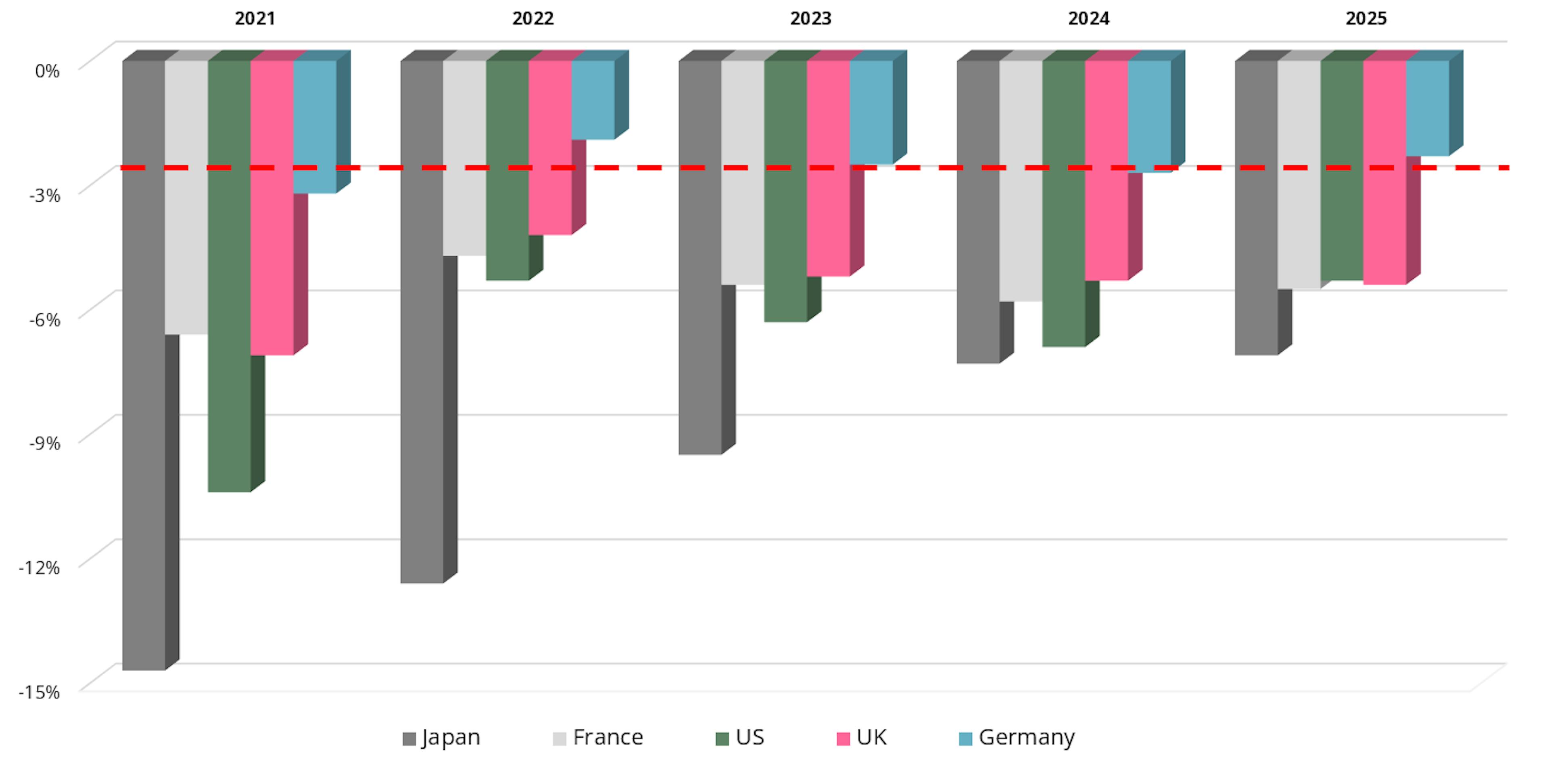
Source: Carmignac, Bloomberg, December 2025.
3) Emerging issuers benefit from a positive momentum
- In a fragmented and unsynchronized global environment, emerging issuers seem better positioned for the future compared to their developed country counterparts.
- Except for Asia, which continues to suffer from the disappointing dynamics of the Chinese epicentre, emerging countries share common characteristics: a widespread decline in consumer prices, modest but positive growth, and controlled debt levels - adjustments were made more than 10 years ago.
- These same so-called emerging countries also benefit from the balkanization of the global chessboard, with the emergence of new powerhouses exporting raw materials, as well as the repatriation of formerly Asian production chains close to Western consumers, or the emergence of a South American alignment with the Trump administration.
- We currently favour emerging market debt issued in local currency, which offers record carry levels and relevant tightening potential (see figure 3), while central banks have adopted restrictive policies so far to maintain inflation in line with their targets.
- Finally, technical factors are also favourable, with an increase in flows into this asset class, which should support valuations in the coming months.
Figure 3: Evolution of the key interest rate of 3 central banks of emerging countries (Czech Republic, Mexico, Brazil)

Source: Carmignac, Bloomberg, December 2025.
4) Inflation : alive & kicking
- We believe that the reforms adopted in 2025 by the Trump administration will begin to impact the US economy during the first half of 2026 (see figure 4). While the current inflation level remains close to 3% over the past 12 months, the impact of tariffs on the upcoming rounds of statistics will undoubtedly be bad news for the Fed, which has limited means to mitigate inflation other than adopting a more restrictive stance.
- Besides the implementation of tariffs, we think that the new immigration policy decided by the American administration could lead to increased tensions in the labour market and higher wages. Given the remigration policy and the sharp halt of new immigration, these reforms could heighten the risk of a price-wage spiral, which is generally highly inflationary in the long term.
- Nevertheless, we believe that this scenario represents a relevant investment opportunity as it doesn't seem to be factored in by the market consensus, which aligns with a stable inflation scenario at 2.5% for the coming years. Whenever we observe stronger-than-expected inflation statistics, allocation in inflation-indexed bonds or inflation swaps can generate additional performance.
- We can also extend this trend to the eurozone, where inflation has significantly benefited from the decrease in commodity prices in 2025 but still remains above the 2% target set by the ECB with a certain risk of resurgence for the same reasons of fiscal stimulus and protectionism.
- Given that geopolitical tensions remain high, we believe that inflation-linked instruments can also serve as a macroeconomic hedge in case of potential increases in commodity prices. With crude oil prices returning to January 2021 levels, the upside risk is considerable.
Figure 4: The inflationary rebound seems inevitable in the United States

Source: Bureau of Economic Analysis, S&P Global, Carmignac, December 2025.
5) An option for the current market configuration: Carmignac Portfolio Flexible Bond
- Given the elements discussed previously, the current environment may initially leave one circumspect or dubious regarding the approach to adopt due to high valuation levels and economic imbalances. But it is precisely action that must prevail over wait-and-see in a context where risk-free returns (monetary, euro funds, or structured products) are generally below inflation.
- In our view, inflation-indexed instruments remain one of the last attractive sub-segments in the bond market, while other corporate and government bonds show limited potential for additional compression. With 20% of the portfolio invested in inflation-indexed bonds and over 300 basis points of duration invested in inflation swaps, Carmignac Portfolio Flexible Bond is well positioned to benefit from sustained inflation in the future.
- Moreover, while conventional bond strategies typically suffer during episodes of inflation resurgence due to consecutive adjustments that can occur on yield curves, the fund’s flexible mandate allows us to adopt a neutral or negative sensitivity through derivative instruments, to take advantage of a rising rate environment.
- This flexibility also manifests in the global allocation of the portfolio within money market assets or through hedging strategies that protect the fund from sometimes excessive valuation levels, particularly in credit, while discretionary capital allocation in a selection of issuers offering attractive risk-adjusted remuneration levels.
- Since the arrival of the co-portfolio management team, Guillaume Rigeade and Eliezer Ben Zimra in July 2019, Carmignac Portfolio Flexible Bond has outperformed the bond markets in all market regimes, with end-of-cycle and contraction phases being particularly generative of relative performance (see figure 5). We believe the fund is well positioned to achieve robust performance in the coming months due to the diversity of its performance drivers and its low correlation with traditional fixed income indices.
Figure 5: Absolute and Relative performance of the Carmignac P. Flexible Bond fund since the arrival of the portfolio managers (09/07/2019)

Source: Carmignac, ICE Bank of America, Bloomberg, 31/12/2025. Past performance is not a reliable indicator of future performance. Reference indicator : ICE BofA Euro Broad Market Index. On 30/09/2019 the composition of the reference indicator changed: the ICE BofA ML Euro Broad Market Index coupons reinvested replaces the EONCAPL7. Performances are presented using the chaining method.

Carmignac Portfolio Flexible Bond
A flexible solution aiming to capture bond opportunities globally