
Inflation is firmly back on investors' radar after several decades of absence. The sharp rise in prices witnessed in 2022, driven by massive post-pandemic fiscal stimulus and the outbreak of the war in Ukraine, was initially viewed as a temporary phenomenon. Yet a growing number of developments now suggest that structurally higher inflation may become the new baseline scenario.
Beyond the inflation shock of 2022, several long-term structural trends point in the same direction. Ageing demographics, a slowing Chinese labour force, the energy transition, the reindustrialisation of Western economies, increasingly expansionary fiscal policies and growing geopolitical fragmentation are gradually eroding the disinflationary forces that shaped the global economy over the past three decades. These structural trends are now being reinforced by a series of cyclical developments that continue to fuel price pressures.
The war between Russia and Ukraine continues to drag on at Europe's doorstep. Beyond its impact on energy and commodity prices, it has highlighted the urgent need for Western countries to strengthen their defence capabilities. Germany's ambition to raise defence spending to 3.5%1 of GDP by 2029 illustrates a broader trend that is likely to support public and industrial demand for years to come.
More recently, the resurgence of tensions involving Iran has highlighted how fragile the global energy balance remains. This has been compounded by the United Arab Emirates' withdrawal from OPEC+ at the end of April 2026, signalling growing divergence among major oil-producing countries and pointing towards a potentially more volatile oil market.
In US, inflationary pressures remain equally persistent. Recent inflation readings have reached their highest levels since May 2023. Higher fuel prices, tariffs, tighter immigration policies and expansionary fiscal measures all reinforce the view that structurally higher US inflation is far from a remote scenario.
Artificial Intelligence is also contributing to this new inflationary landscape. While the technology promises significant productivity gains over the long term, the computing power required to support these models demands massive investment in data centres, electricity grids, water infrastructure and strategic components such as semiconductors. The inflationary effects of this investment cycle may therefore precede the productivity benefits by several years.
Taken together, these developments point towards the return of a more cyclical economic environment, characterised by more frequent rotations across sectors, investment styles, regions and even asset classes. In such a world, passive strategies, often concentrated in the winners of the previous cycle, are likely to become increasingly vulnerable to regime shifts. By contrast, active and flexible management provides the tools required to adapt to these changing market conditions and capture the opportunities they create. This conviction lies at the heart of Frédéric Leroux's management of Carmignac Investissement Latitude and is shared with Pierre-Edouard Bonenfant in the management of Carmignac Portfolio Inflation Solution.
Carmignac Investissement Latitude: Adapting to equity market rotations
While passive investing has benefited enormously from the past fifteen years of structurally low interest rates, the return of economic cyclicality could gradually reshape market leadership. More resilient inflation and higher market volatility are likely to put pressure on the valuations of long-duration growth assets, which now account for an increasingly large share of global equity indices. In this environment, the ability to actively identify tomorrow's winners while dynamically managing portfolio risk becomes a key differentiator.
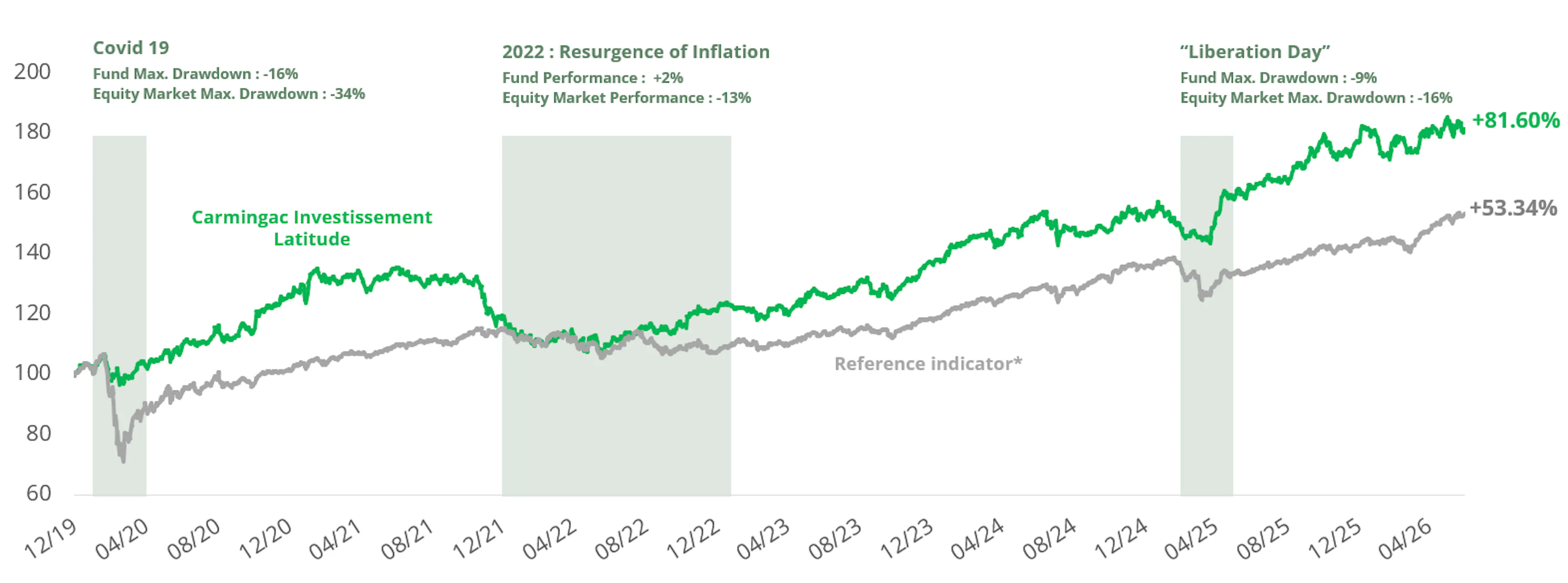
Carmignac Investissement Latitude was designed precisely with this objective in mind. Its ambition is to allow investors to capture the long-term wealth creation potential of global equities while seeking to reduce portfolio volatility, delivering a smoother return profile throughout market cycles.
As a feeder fund into Carmignac Investissement, the strategy benefits from more than 35 years of expertise in global stock selection. Free from geographical, sector, style or market capitalisation constraints, the underlying portfolio displays an Active Share of around 80%2, reflecting a positioning that differs significantly from traditional market indices. Rather than replicating yesterday's winners, this unconstrained approach seeks to identify companies exposed to long-term structural trends and future sources of performance arising from sector, geographical and style rotations, as well as technological revolutions that typically accompany regime changes.
The strategy also seeks to mitigate the impact of short-term market corrections. Frédéric Leroux can dynamically adjust the fund's net equity exposure between 0% and 100% through a macro-overlay strategy implemented using equity index futures. The objective is not to alter the portfolio's long-term investment convictions, but rather to limit the impact of market stress episodes on overall performance. While equities remain the best-performing asset class over the long run, they are also among the most volatile. By seeking to reduce the magnitude of major drawdowns, the strategy aims to avoid the behavioural pitfalls that often lead investors to sell at market lows, crystallising losses and missing the subsequent recovery. Tactical market timing is therefore delegated to the portfolio manager, relieving investors of what is often one of the most difficult tasks in investing.
Meanwhile, equity markets continue to reach new highs, driven by a handful of Artificial Intelligence leaders. Although the long-term outlook for these companies remains compelling, more persistent inflation could challenge today's exceptionally rich valuations. IPO activity is accelerating once again, while US household equity allocations have reached their highest levels since the dot-com bubble. Such market concentration leaves investors increasingly exposed to a shift in the macroeconomic regime. At the same time, Kevin Warsh's appointment as Chair of the Federal Reserve, together with his stated intention to reduce the use of forward guidance, could lead to greater volatility in rates and, by extension, in long-duration growth assets. In this environment, more frequent rotations across sectors, investment styles and regions are likely to reinforce the case for an active and flexible strategy such as Carmignac Investissement Latitude.
Carmignac Portfolio Inflation Solution: Multi-asset strategy for a structurally higher inflation regime
The prospect of structurally higher inflation calls into question many of the asset allocation principles that have prevailed over recent decades. Traditional 60/40 portfolios3, which have benefited from persistently low interest rates and a negative correlation between equities and bonds, may gradually lose their effectiveness. The 1970s already demonstrated how oil shocks, persistent inflation and rising interest rates could simultaneously penalise both asset classes. More recently, 2022 provided a stark reminder, with significant losses across both equity and bond markets.
Periods of elevated inflation also fundamentally alter the relationship between asset classes. A traditional "balanced" portfolio loses much of its diversification benefit when US equities and sovereign bonds become positively correlated, with correlation rising from around zero to nearly 0.7. The same observation applies to gold which, although still widely regarded as a safe-haven asset, has become increasingly correlated with financial markets. In this environment, investors need exposure to assets whose return drivers remain genuinely independent from traditional markets. Commodities fulfil this role particularly well. Their low correlation with other asset classes (below 0.2) makes them not only an effective source of decorrelation, but also a source of diversification and a source of potential performance driver during inflationary periods4.
Carmignac Portfolio Inflation Solution was specifically designed to address this challenge. Its objective is to generate performance throughout the different phases of the inflation cycle by combining a flexible, actively managed allocation across multiple asset classes.
- During periods of accelerating inflation, the strategy seeks exposure to assets most likely to benefit from rising prices. The portfolio invests directly in commodities (through ETCs and mining companies) while expressing inflation views primarily through inflation swaps. Unlike inflation-linked bonds, these instruments provide direct exposure to inflation expectations without suffering from the negative impact of rising nominal rates.
- Conversely, when inflationary pressures begin to ease and interest rates stabilise, new investment opportunities emerge. Traditional assets become more attractive once again, allowing the portfolio to gradually reposition towards these segments of the market.
As inflation regains momentum, technology stocks continue to reach new highs, supported by the strong earnings growth expected from Artificial Intelligence leaders. Frédéric Leroux and Pierre-Edouard Bonenfant therefore remain constructive on equities over the short term, while recognising that an inflation surprise could quickly challenge today's market environment. The portfolio is consequently built with a balanced allocation, combining equity exposure with meaningful positions in commodities (energy, precious metals and industrial metals) and dedicated inflation strategies. On fixed income, given the elevated debt levels across developed economies, continued fiscal expansion and the inflation outlook, the managers maintain an overall neutral duration. Looking further ahead, they also believe that the return of economic cyclicality is likely to broaden market leadership beyond US equities. This conviction is reflected in an overweight allocation to emerging markets, which could benefit from a gradual reallocation of global capital flows alongside a weaker US dollar.
In an environment where inflation may once again become a defining market force, the objective is no longer simply to protect portfolios against its effects, but also to capture the opportunities it creates throughout the cycle. This is precisely the philosophy behind Carmignac Portfolio Inflation Solution. By dynamically adjusting its exposures across commodities, inflation strategies, fixed income and equities, the strategy seeks to transform changes in the inflation cycle into potential sources of long-term performance.

1Sources: FT.com.
2Data as of 31/05/2026.
3Traditional portfolio: 60% Equities/40% Bonds.
4Source: Bloomberg. Bonds: ECAS Index; US Equities: S&P 500; Commodities: Bloomberg Commodity Index (BCOM). Monthly correlations. Periods considered: 2010–2021 and 2022–June 2026.

Carmignac Investissement Latitude

Carmignac Portfolio Inflation Solution
Carmignac Investissement Latitude A EUR Acc
- Recommended minimum investment horizon
- 5 years
- Risk indicator*
- 3/7
- SFDR - Fund Classification**
- Article 8
*Risk Scale from the KID (Key Information Document). Risk 1 does not mean a risk-free investment. This indicator may change over time. **Sustainable Finance Disclosure Regulation (SFDR) 2019/2088. The SFDR classification of the Funds may change over time.
Main risks of the fund
Fees
- Entry costs
- 4,00 % of the amount you pay in when entering this investment. This is the most you will be charged. Carmignac Gestion doesn't charge any entry fee. The person selling you the product will inform you of the actual charge.
- Exit costs
- We do not charge an exit fee for this product.
- Management fees and other administrative or operating costs
- 1,80 % of the value of your investment per year. This estimate is based on actual costs over the past year.
- Performance fees
- 20,00 % max. of the outperformance once performance since the start of the year exceeds that of the reference indicator and if no past underperformance still needs to be offset. The actual amount will vary depending on how well your investment performs. The aggregated cost estimation above includes the average over the last 5 years, or since the product creation if it is less than 5 years.
- Transaction Cost
- 0,33 % of the value of your investment per year. This is an estimate of the costs incurred when we buy and sell the investments underlying the product. The actual amount varies depending on the quantity we buy and sell.
Performance
| Carmignac Investissement Latitude | +7,9 | +16,9 | +10,2 | +13,2 | +2,1 | −6,2 | +27,0 | +9,1 | −16,1 | +0,3 |
| Reference Indicator | +9,4 | +5,1 | +14,2 | +10,5 | −6,6 | +12,9 | +1,8 | +28,9 | −4,8 | +8,9 |
| Carmignac Investissement Latitude | +14,8 % | +7,8 % | +6,3 % |
| Reference Indicator | +11,3 % | +6,6 % | +8,3 % |
Source: Carmignac at Oct 30, 2026.
Past performance is not necessarily indicative of future performance. Performances are net of fees (excluding possible entrance fees charged by the distributor). The Fund presents a risk of loss of capital.
The return may increase or decrease as a result of currency fluctuations, for the shares which are not currency-hedged.
Reference Indicator: 50% MSCI AC World NR index + 50% €STR Capitalized Index. Rebalancing Frequency: Quarterly
Carmignac Portfolio Inflation Solution I EUR Acc
- Recommended minimum investment horizon
- 5 years
- Risk indicator*
- 3/7
- SFDR - Fund Classification**
- Article 6
*Risk Scale from the KID (Key Information Document). Risk 1 does not mean a risk-free investment. This indicator may change over time. **Sustainable Finance Disclosure Regulation (SFDR) 2019/2088. The SFDR classification of the Funds may change over time.
Main risks of the fund
Fees
- Entry costs
- We do not charge an entry fee.
- Exit costs
- We do not charge an exit fee for this product.
- Management fees and other administrative or operating costs
- 1,11 % of the value of your investment per year. This estimate is based on actual costs over the past year.
- Performance fees
- 20,00 % when the share class overperforms the Reference indicator during the performance period. It will be payable also in case the share class has overperformed the reference indicator but had a negative performance. Underperformance is clawed back for 5 years. The actual amount will vary depending on how well your investment performs. The aggregated cost estimation above includes the average over the last 5 years, or since the product creation if it is less than 5 years.
- Transaction Cost
- 0,50 % of the value of your investment per year. This is an estimate of the costs incurred when we buy and sell the investments underlying the product. The actual amount varies depending on the quantity we buy and sell.
Performance
| Carmignac Portfolio Inflation Solution | +6,6 | +12,9 | +3,2 | −0,1 |
| Reference Indicator | +2,9 | +2,1 | +1,9 | +0,0 |
| Carmignac Portfolio Inflation Solution | +5,4 % | +0,0 % | +7,8 % |
| Reference Indicator | +3,2 % | +0,0 % | +2,4 % |
Source: Carmignac at Oct 30, 2026.
Date of 1st NAV : 15/12/2023.
Past performance is not necessarily indicative of future performance. Performances are net of fees (excluding possible entrance fees charged by the distributor). The Fund presents a risk of loss of capital.
The return may increase or decrease as a result of currency fluctuations, for the shares which are not currency-hedged.
Reference Indicator: Eurostat Euro HICP ex Tobacco index