
Markets are currently navigating a paradox. Interest rates are back close to post-Covid highs, geopolitical risks remain unresolved, and inflationary pressures are resurfacing. Yet equity and credit assets have continued to prove resilient, largely supported by corporate earnings; a theme we explored in our article the price of resilience.
For investors, this raises a central question: should a fund like Carmignac Patrimoine still be exposed to risky assets? We believe the answer is yes but not all of them. In other words, the question is not whether to take risk. It is which risks are still worth taking.
This is especially true as the traditional definition of “risky assets” has become less clear-cut. Gold, usually seen as a safe-haven asset, has behaved more like a momentum asset, while rates have at times been a source of volatility rather than protection. For the purpose of this article, we focus on three areas where risk-taking remains central to portfolio construction: equities, credit and emerging markets debt.
Equity - our preferred growth engine

On equities, we remain globally constructive. It is true that valuations are no longer cheap: US indices are close to all-time highs, leadership has become narrower, and short-term volatility remains unstable against a still uncertain geopolitical backdrop. The elephant in the room for valuations is, of course, the strong move in rates. Higher yields raise the discount rate applied to future earnings and make valuation discipline even more important, particularly in the most expensive parts of the market. But rates alone are not enough for now to justify stepping away from equities when fundamentals continue to deliver. In the US in particular, corporate earnings have been remarkably resilient, with first-quarter profits for S&P 500 companies surprising well above expectations. This earnings momentum is one of the key reasons why equities have been able to absorb higher rates, inflation concerns and geopolitical noise.
That said, the market is becoming more selective. What has worked recently is clear: US exposure, Artificial intelligence (AI) exposure and momentum. At the same time, participation has weakened, with only a small number of stocks driving index performance. This is not necessarily a sign of irrational exuberance; it also shows that investors are increasingly discriminating between companies that can deliver earnings and those that cannot.
Our long-term conviction on AI remains intact. We see it not simply as a market narrative, but as a structural shift in capital allocation, with technology representing a growing share of global investment. However, being positive on AI does not mean being indiscriminately exposed to the whole technology sector. After a strong rally, we have taken regular and incremental profits on parts of our semiconductor exposure, especially in higher-beta names. This is not a change in our long-term view, but a disciplined way to manage valuation risk and portfolio concentration.
At the same time, we have been reinforcing the rest of the equity portfolio. The market’s focus on AI has left other areas neglected, creating opportunities in companies with solid fundamentals and more reasonable valuations. This is why we continue to build a more balanced equity exposure, combining long-term growth themes with diversifiers such as defensive US healthcare distributors, Berkshire Hathaway, and selected Emerging Market banks.
In practice, our approach is a barbell: staying exposed to the structural winners, while adding resilient and attractively valued businesses outside the most crowded parts of the market. We also use put options when market complacency appears excessive and the cost of protection becomes attractive. These out-of-the-money options are designed to protect the portfolio in the event of a significant market shock. In other words, we have a hierarchy of probabilities, but we build the portfolio to survive being wrong. We are therefore positive on equities, but the message is clear: with rates having moved sharply, valuation discipline is central to portfolio construction.
Credit - selective carry, no broad beta

After two years of strong performance, credit has been one of the most rewarding areas of fixed income, largely because carry proved far more effective than long-duration government bonds. However, the strong demand for yield has also pushed valuations higher, leaving less margin for error.
Credit markets have shown solid resilience during recent episodes of volatility, including the stress that followed “Liberation Day”1. Yet this resilience should not be confused with the absence of risk. We believe the new protectionist environment, persistent supply-chain disruptions and the risk of higher-for-longer inflation could put pressure on more vulnerable issuers, especially in sectors such as consumer goods, autos, chemicals and export-driven industries. At the same time, a higher cost of capital increases refinancing risk and should contribute to a gradual normalisation of default rates.
This is why we do not believe the best opportunity today lies in broad credit beta. In a multi-asset portfolio, we would rather take directional risk through equities, where upside participation is more compelling, than through generic credit exposure, where spreads already reflect a significant amount of optimism.
That said, credit remains a deep and inefficient market, which creates opportunities for active investors. The key is to focus on areas where carry is supported by fundamentals. We continue to see value in selected high-yield bonds, particularly in energy, where companies have rationalised their business models after years of underinvestment and can also benefit from heightened geopolitical tensions, as recently illustrated by renewed concerns around the Strait of Hormuz, and in financial debt, especially European banks, whose balance sheets have been structurally strengthened by post-2008 regulation. Structured credit can also offer attractive risk-adjusted opportunities when carefully selected.
Given the current valuation backdrop, hedging remains essential. A strategy combining idiosyncratic credit selection with protection through credit indices or CDS can help preserve carry while limiting exposure to a broader spread-widening episode. CDS positions hedge credit risk directly, but they also provide broader protection against a deterioration in risk sentiment across markets, including equities, making them an efficient way to protect multi-asset portfolios against a wider risk-off episode.
EM debt & currencies - the spicy diversifier

Emerging markets entered 2026 from a position of strength, supported by higher real rates, stronger external balances and more credible policy frameworks. The volatility triggered by the March oil shock did not lead to broader financial stress, highlighting the improved resilience of the asset class versus previous crisis episodes.
The case for EM debt remains supported by attractive carry, improving fundamentals, lower US real yields and a softer dollar. However, valuations are no longer uniformly cheap, meaning investors need to focus less on broad beta exposure and more on country, currency and credit selection. Opportunities such as Mexican debt or selected African sovereigns, including Ivory Coast, illustrate how value can still be found.
FX appear to be most compelling opportunities, and we continue to favour currencies where carry, valuation and external dynamics offer, for us, the best asymmetry. Latin America remains a core area of conviction, with the Brazilian real and Chilean peso standing out thanks to attractive carry, deep liquidity and supportive macro frameworks. That said, we remain cautious on local rates, as elevated oil prices and renewed inflation pressures could force some central banks to pause easing cycles or even resume hikes.
Carmignac Patrimoine positioning
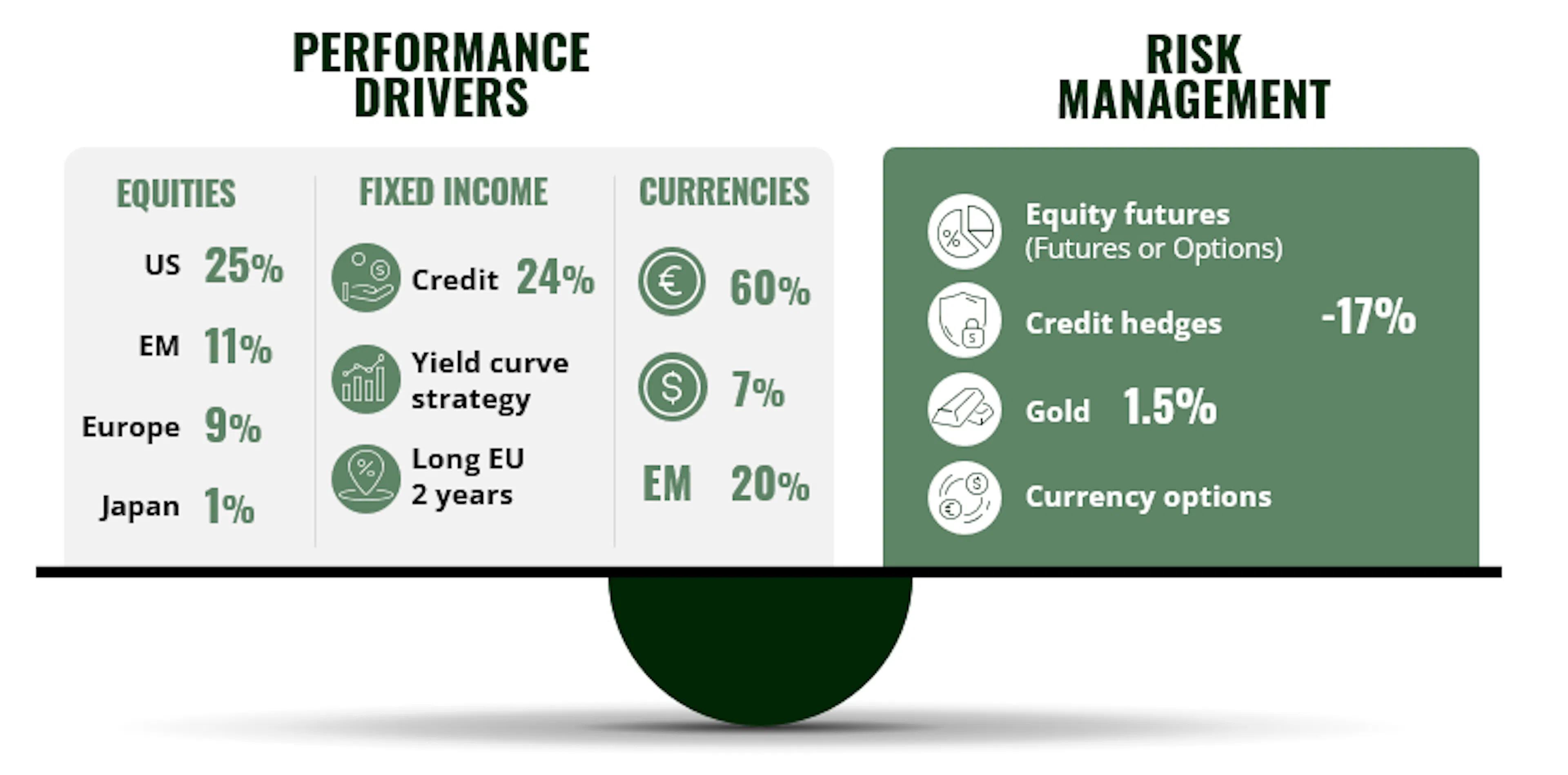
Building a diversified portfolio such as Carmignac Patrimoine therefore means allocating capital where the risk-reward profile appears most compelling. This requires a clear view on risk assets, but also a broader portfolio construction discipline to avoid simply accumulating correlated risks.
In this context, and given that the equity-bond correlation is more positive than in the past, our exposure to the risk assets discussed above must be balanced with complementary portfolio levers. For example, maintaining a low, or even negative, modified duration in the United States can help offset the risk of renewed upward pressure on yields and provide a more robust overall portfolio structure.
Ultimately, the objective is not only to identify attractive investment opportunities, but to combine them in a way that preserves diversification, mitigate drawdowns and improves the portfolio’s ability to perform.

Carmignac Patrimoine
Carmignac Patrimoine A EUR Acc
- Recommended minimum investment horizon
- 3 years
- Risk indicator*
- 3/7
- SFDR - Fund Classification**
- Article 8
*Risk Scale from the KID (Key Information Document). Risk 1 does not mean a risk-free investment. This indicator may change over time. **Sustainable Finance Disclosure Regulation (SFDR) 2019/2088. The SFDR classification of the Funds may change over time.
Main risks of the fund
Fees
- Entry costs
- 4,00 % of the amount you pay in when entering this investment. This is the most you will be charged. Carmignac Gestion doesn't charge any entry fee. The person selling you the product will inform you of the actual charge.
- Exit costs
- We do not charge an exit fee for this product.
- Management fees and other administrative or operating costs
- 1,80 % of the value of your investment per year. This estimate is based on actual costs over the past year.
- Performance fees
- 20,00 % max. of the outperformance once performance since the start of the year exceeds that of the reference indicator and if no past underperformance still needs to be offset. The actual amount will vary depending on how well your investment performs. The aggregated cost estimation above includes the average over the last 5 years, or since the product creation if it is less than 5 years.
- Transaction Cost
- 0,32 % of the value of your investment per year. This is an estimate of the costs incurred when we buy and sell the investments underlying the product. The actual amount varies depending on the quantity we buy and sell.
Performance
| Carmignac Patrimoine | +3,2 | +12,1 | +7,1 | +2,2 | −9,4 | −0,9 | +12,4 | +10,5 | −11,3 | +0,1 |
| Reference Indicator | +2,7 | +1,1 | +11,4 | +7,7 | −10,3 | +13,3 | +5,2 | +18,2 | −0,1 | +1,5 |
| Carmignac Patrimoine | +8,2 % | +2,0 % | +2,8 % |
| Reference Indicator | +6,9 % | +4,1 % | +5,6 % |
Source: Carmignac at Apr 30, 2026.
Past performance is not necessarily indicative of future performance. Performances are net of fees (excluding possible entrance fees charged by the distributor). The Fund presents a risk of loss of capital.
The return may increase or decrease as a result of currency fluctuations, for the shares which are not currency-hedged.
Reference Indicator: 40% MSCI AC World NR index + 40% ICE BofA Global Government Index + 20% €STR Capitalized Index. Rebalancing Frequency: Quarterly