
Takeaways from the 2025 voting season

The Annual General Meeting (AGM) season is a key moment in the active asset manager’s calendar: a time for shareholders to have their say and the management of corporates to gauge their investors’ priorities.
The 2025 AGM season unfolded amid evolving government policies, market turbulence and increasing sustainability regulation in both Europe and the US. This vital forum has provided illuminating insights into the shifting state of play between corporates and investors.
Shareholder oversight under threat
The number of resolutions filed by shareholders at US companies declined 30% in 2025 compared to last year1. This was largely influenced by the stricter stance taken by the US Securities and Exchange Commission, as well as a shift in many asset managers’ approach to Environmental, Social and Governance (ESG) issues and voting. We had grown increasingly concerned about the misuse of shareholder resolutions by some investors and commend ‘resolution rationality’. But unfortunately, this regulatory change has had a direct impact on shareholders’ ability to hold boards to account.
European companies have traditionally been more insulated from shareholder filings, because of share ownership structures and in certain countries, the authority granted to boards to determine whether resolutions are included on AGM agendas. And this AGM season, the ‘fewer-resolutions’ trend was even more pronounced. A notable example was the Dutch activist group Follow This, who are renowned for submitting climate-related resolutions at AGMs of major European oil and gas companies. This year the group chose not to file any resolutions, citing insufficient investor backing2.
Corporate governance withstands the backlash
While the politicisation of ESG, along with the evolution of European and US government policy and regulation, has impacted investors’ and issuers’ approaches to sustainability, corporate governance appears to have bucked the trend.
This year there were a considerable number of votes against management on governance topics. For example, at three of the companies held by our portfolios, votes against executive pay reports surpassed 50%3.
In addition, our data, as evidenced in the chart below, shows more governance shareholder-led resolutions were filed in companies held by our portfolios than resolutions on environmental and social topics.
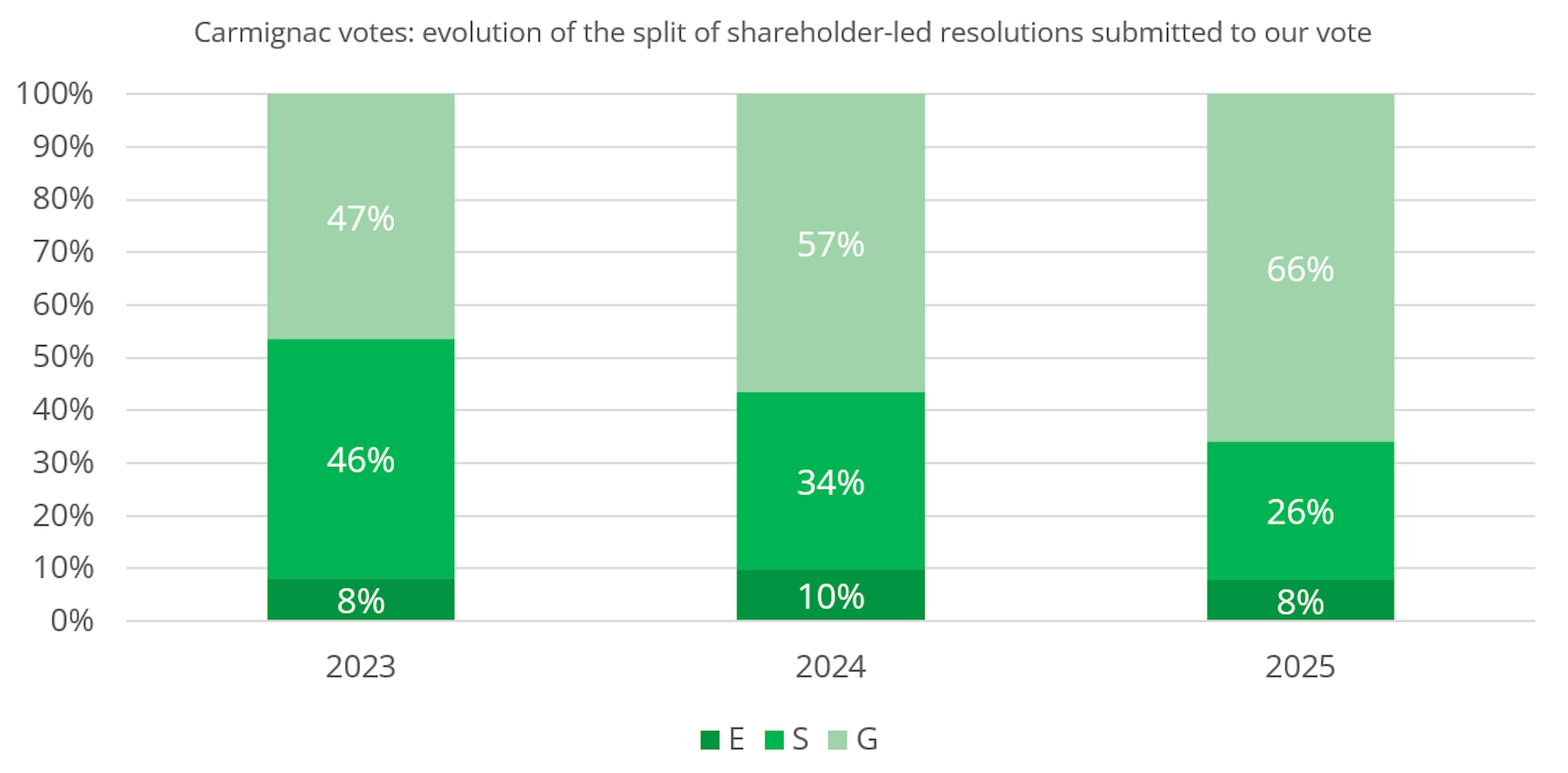
This trend is confirmed at market-level. According to Morningstar, the volume of environmental and social resolutions decreased by 42% in 2025, compared with a fall of just 6% for governance resolutions4.
Governance shareholder-led resolutions also continue to garner stronger support from shareholders. Although the overall average level of support for shareholder resolutions held steady this year at 23%, Morningstar notes a clear divergence: governance proposals consistently received higher backing than environmental and social ones. This pattern is further reflected in the voting results across our portfolios, where the shareholder-led resolutions that received the highest support levels (exceeding 40%) were governance-focused5. While it remains too early to evaluate the long-term impact, these elevated support levels highlight a continued interest in governance best practice among investors.
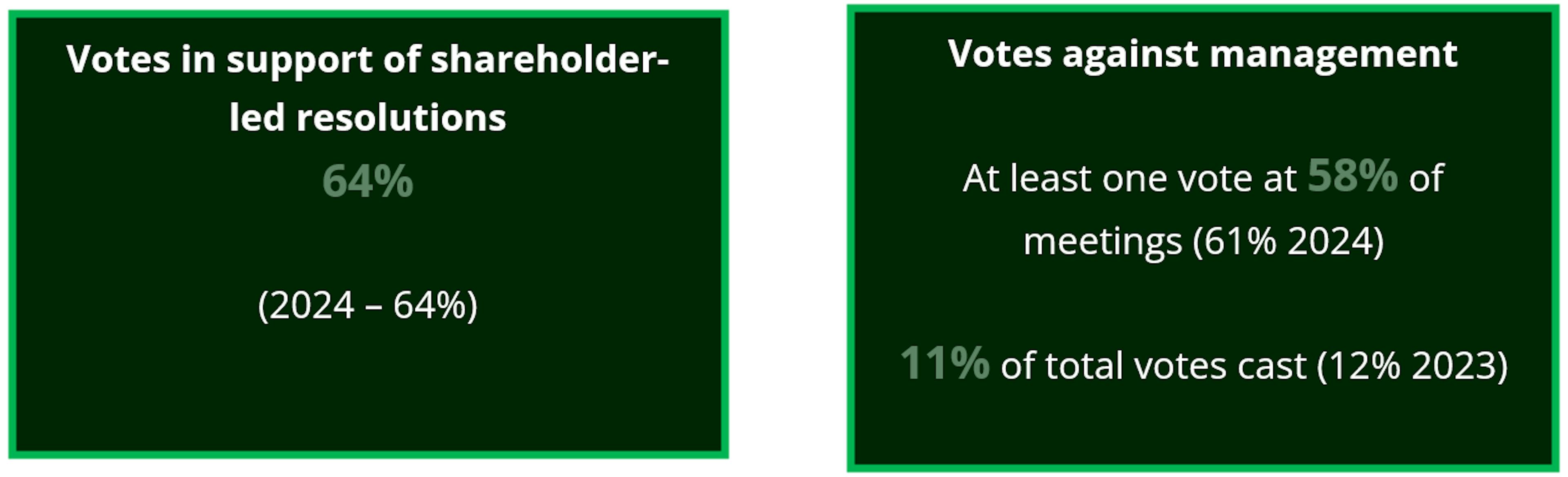
The quality of the governance resolutions brought forward to a vote is also apparent from Carmignac’s records. While our overall backing of shareholder-led resolutions remained high at 64% (70% when excluding ‘anti-ESG’6 resolutions) our highest area of support was governance7.

The positive reach and influence that shareholder-led resolutions can have was recently illustrated when Meta, a controlled technology company, responded to a shareholder vote at its 2024 AGM by amending its corporate governance guidelines. These amendments strengthened the role of the lead director on the board, granting them approval authority over board meeting agenda items. The resolution was initially opposed by management and received support from only 17% of shareholders, including Carmignac, yet it still prompted a structural governance change.
The new era of AGMs has brought renewed focus to corporate governance but minority shareholder rights remain vulnerable, especially given debates surrounding European market competitiveness. A recent example is the strong shareholder backing for the payments company, Wise’s decision to shift its primary listing from the UK to the US, despite the continuation of a controversial dual-class share structure and the dilution of governance standards, both of which negatively affect minority shareholder protections. Therefore, Carmignac voted against all resolutions at the shareholder meeting held on 28th July.
Carmignac’s constant voting stance in changing times
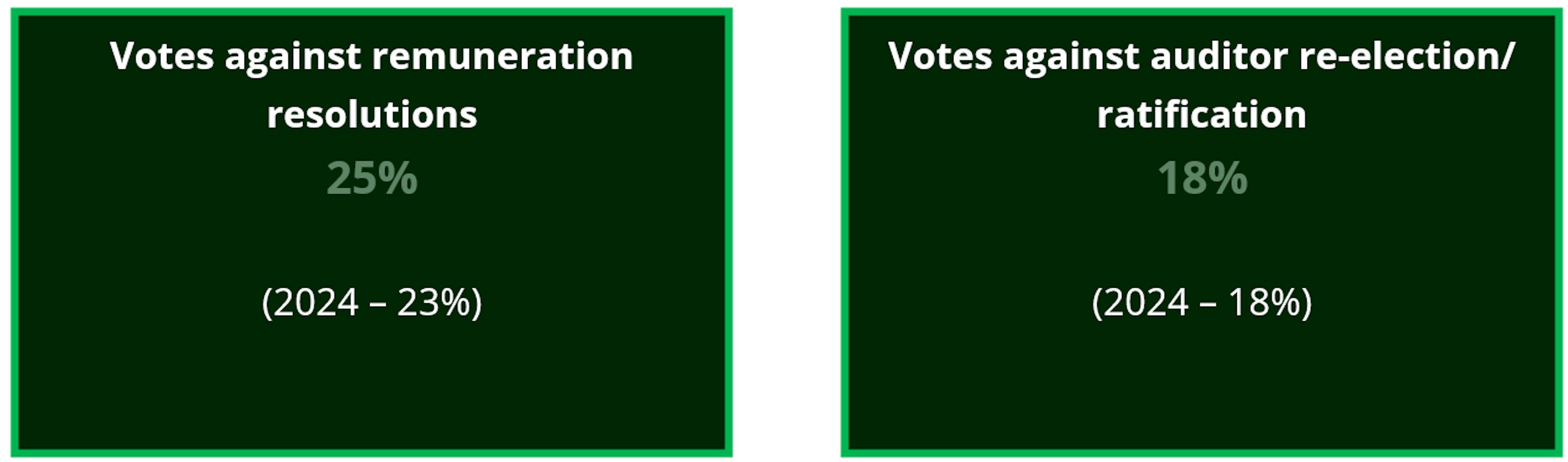
While the landscape is changing, we’ve remained steadfast in our voting approach and in holding corporate management teams to account on ESG issues. We share our key statistics below.
1Morningstar, The 2025 Proxy Season in 7 Charts, 25 July 2025.
2Follow This, Press Release, 10 April 2025; https://www.follow-this.org/follow-this-pauses-climate-resolutions-for-big-oil-in-2025-amid-investor-hesitation/.
3Source: Carmignac, using ISS ProxyExchange data.
4Source: Morningstar.
5Source: Carmignac, using ISS Proxy Exchange data.
6Anti-ESG resolutions are resolutions filed by shareholders which are politically motivated against the adoption or implementation of ESG considerations by issuers.
7Note that the data does not include shareholder-led resolutions which we categorise as “anti-ESG” as they skew the data. Our policy is to systematically oppose these resolutions as they are politically motivated.
